Foundation · 2 min
1. The trust gap this section has to close
Most testimonial sections are built on a comfortable assumption: that showing people saying nice things makes new visitors more confident. The research says the opposite is closer to the truth for brands shoppers do not already know.
Baymard’s direct-to-consumer research found that 62% of shoppers said they would research an unfamiliar brand elsewhere before buying, and 29% actually left the site during testing to go and find independent opinion. No participant was observed changing a purchase decision on the strength of on-site feedback alone. The reason given repeatedly was that a brand controls what appears on its own site, so anything shown there has probably been curated. One tester summarised it plainly: they would assume negative feedback simply would not be shown.
That finding reframes the whole section. A testimonial section cannot manufacture trust, because the shopper already knows who chose the quotes. What it can do is reduce the need to go looking — by being specific enough, attributed enough and checkable enough that a sceptical visitor stops, reads, and stays. Every design decision in this guide follows from that one job.
The screenshot test. Take any testimonial from your section, strip your logo off it, and imagine it on a competitor’s site. If it would work there unchanged — “Great quality, fast delivery, will buy again” — it is saying nothing about you and a shopper will read it as filler. A testimonial that could only have been written about your product is the only kind worth the space.
Scope. This guide covers the testimonial section as a trust block, wherever it appears — homepage, about page, landing page. Star ratings and customer reviews on the product page are a different mechanism with different rules, covered in the Product detail page guide. Section 5 below covers which of the two you should actually be building.
Foundation · 7 min
2. The six testimonial patterns
These differ in how many voices they show at once and how much verifiable detail each one carries. Read each pattern’s fails when line as carefully as its wins when.
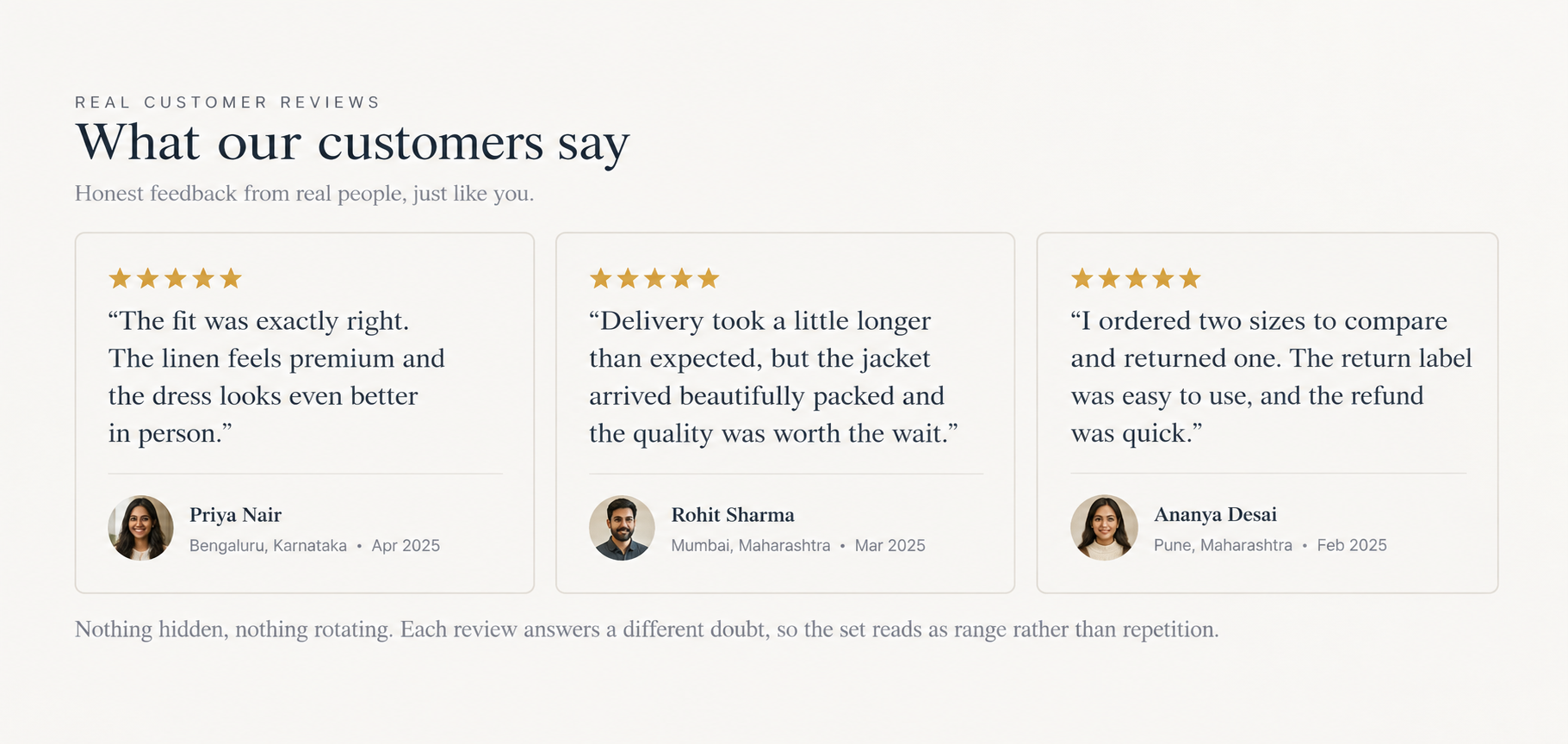
Nothing hidden, nothing rotating. Each quote answers a different doubt, so the set reads as range rather than chorus.
Three to six testimonials visible simultaneously, in a grid or masonry arrangement. Nothing is hidden, nothing rotates, and a shopper can scan the whole set in a few seconds.
Wins when
You have enough genuinely different testimonials that volume itself is the argument, and when the quotes cover different objections — fit, delivery, durability, service — so the set reads as a range of experience rather than a chorus.
Fails when
All six say the same thing in different words. Repetition reads as selection, which is exactly the suspicion you are trying to defuse.
Costs you
Vertical space, and the discipline of keeping quotes similar in length so the grid does not go ragged.
2.2 The rotating carousel
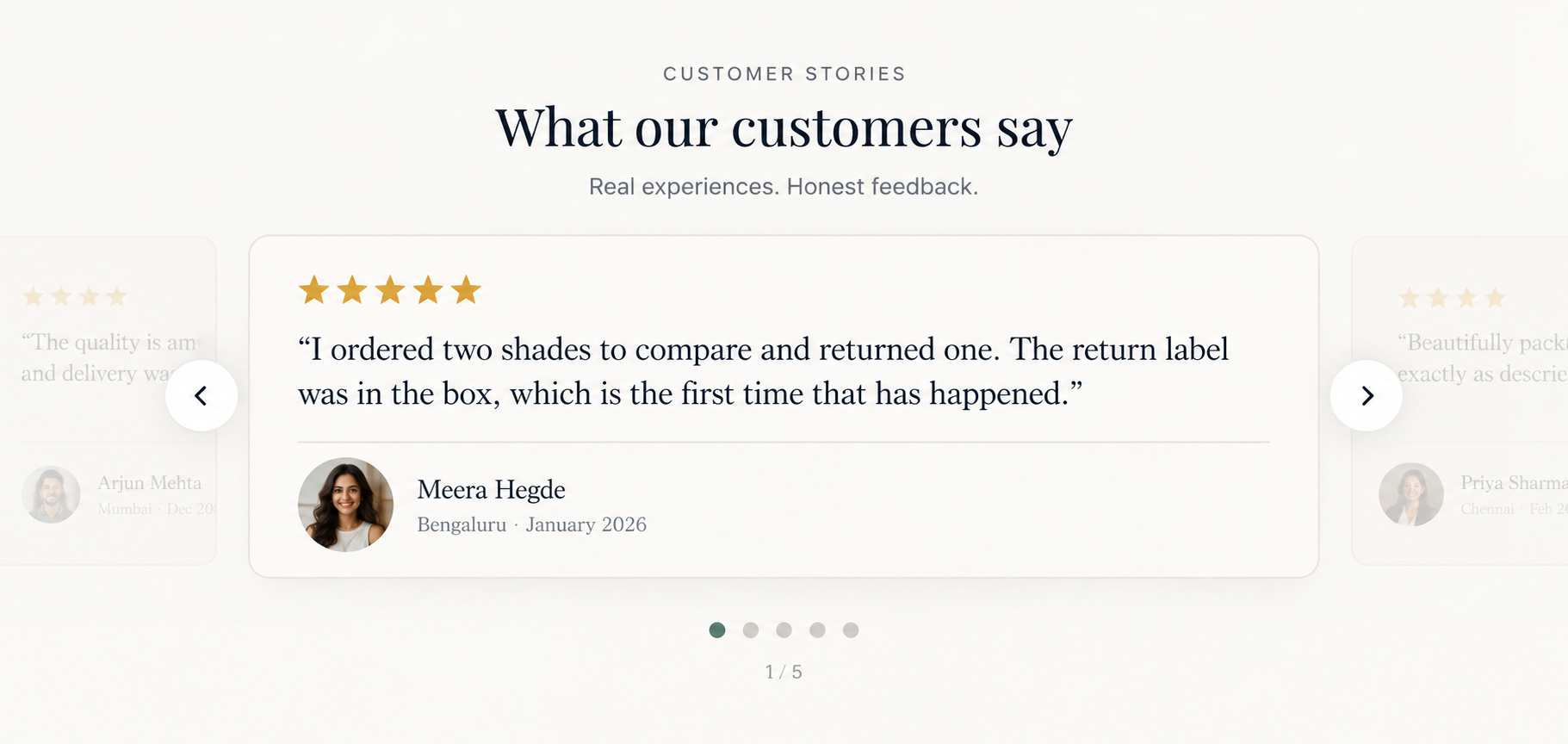
Fits any amount of content into a fixed height, and hides the thing that helps most: how many people are saying it.
One testimonial at a time, with arrows or dots. The most commonly built version, largely because it fits any amount of content into a fixed height.
Wins when
Space is genuinely tight and the testimonials are long enough that showing three at once would mean truncating all of them.
Fails when
It auto-advances. A quote that slides away mid-sentence is worse than no quote, and auto-rotation means most visitors see exactly one testimonial — so you have built a single-quote section with extra engineering. It also hides the one thing that helps most: how many people are saying this.
Costs you
The volume argument, plus real accessibility work — keyboard reachability, visible focus, a pause control, and respect for reduced-motion preferences.
2.3 The featured single quote
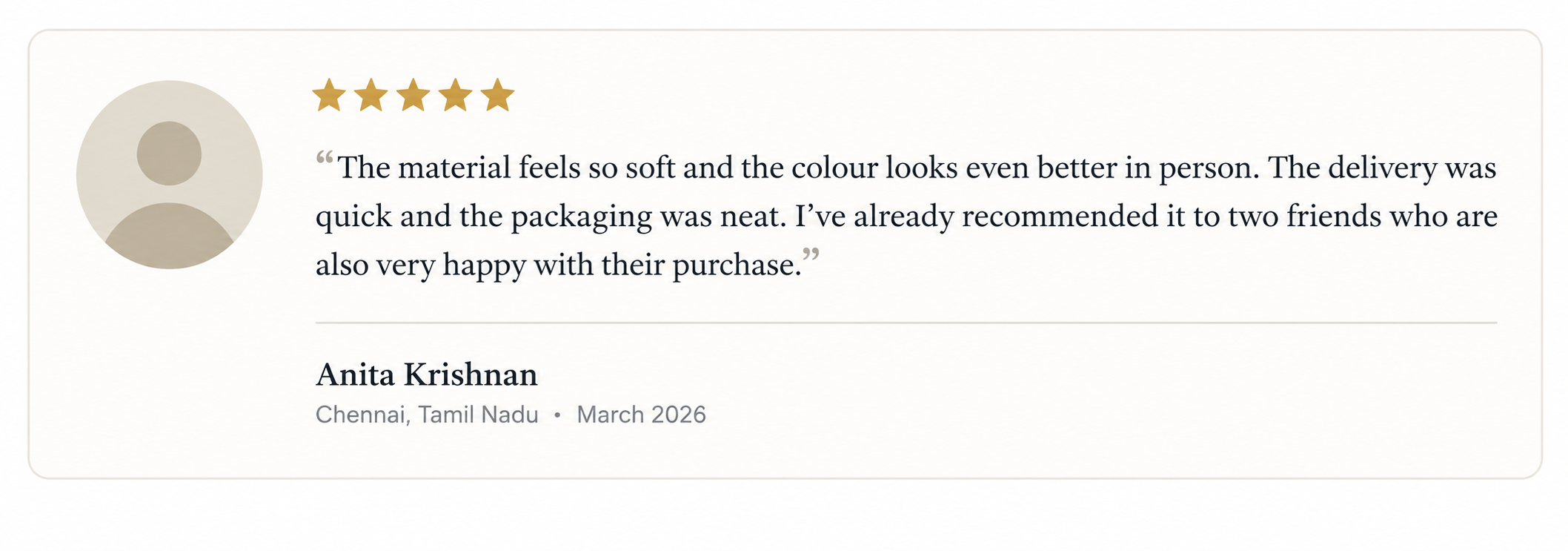
One credible voice, given room. At this size a generic quote has nowhere to hide.
One testimonial, given real space, with full attribution and often a photograph. Treated as editorial rather than as a widget.
Wins when
You have one genuinely strong story — a named customer, a specific situation, a result that can be described concretely. One credible voice outperforms six vague ones.
Fails when
The single quote is generic. At this size there is nowhere to hide: a large “Love it!” is worse than no section at all.
Costs you
Range. One voice speaks to one kind of customer, so pair it with something that shows breadth.
2.4 The rating summary with quotes
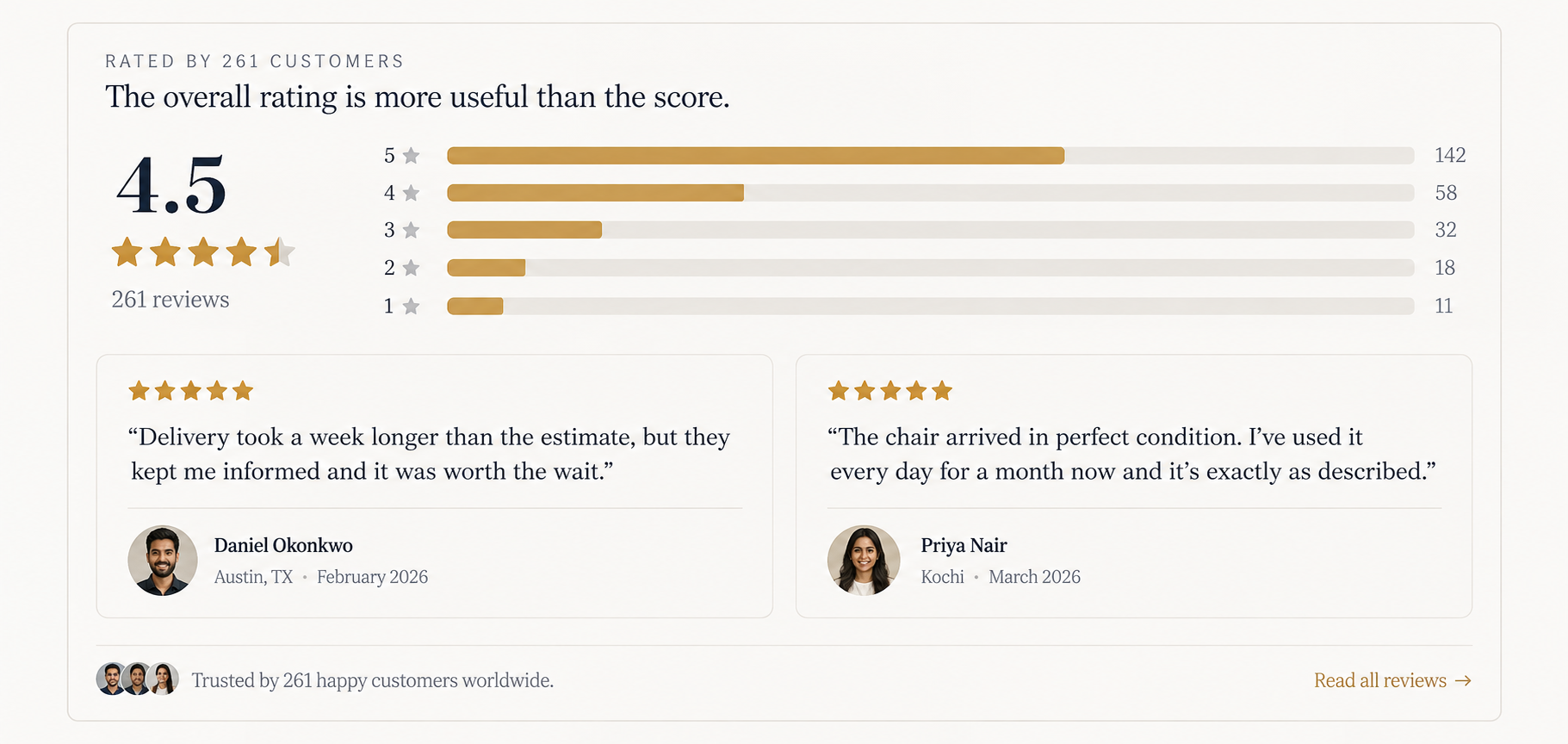
A modest average from a real crowd is more persuasive than a perfect one from almost nobody.
An aggregate score and rating count sitting alongside two or three quotes, usually with a distribution breakdown. The pattern that answers “how many people?” as well as “what did they say?”.
The count is doing more work than the score. Baymard’s survey found nearly twice as many people preferred a product rated 4.5 from 57 users over one rated 5.0 from four — shoppers read a perfect score from a tiny sample as meaningless, and sometimes as suspicious. Showing the distribution, including the one- and two-star rows, does more for credibility than hiding them ever does.
Wins when
You have real volume — enough ratings that the number helps rather than hurts — and ideally an independent platform collecting them.
Fails when
The sample is small. “5.0 from 3 reviews” displayed prominently does active damage; a modest average from a real crowd is more persuasive than a perfect one from almost nobody.
Costs you
Nothing, if the numbers are real. Everything, if you are tempted to round them.
2.5 The customer photo strip
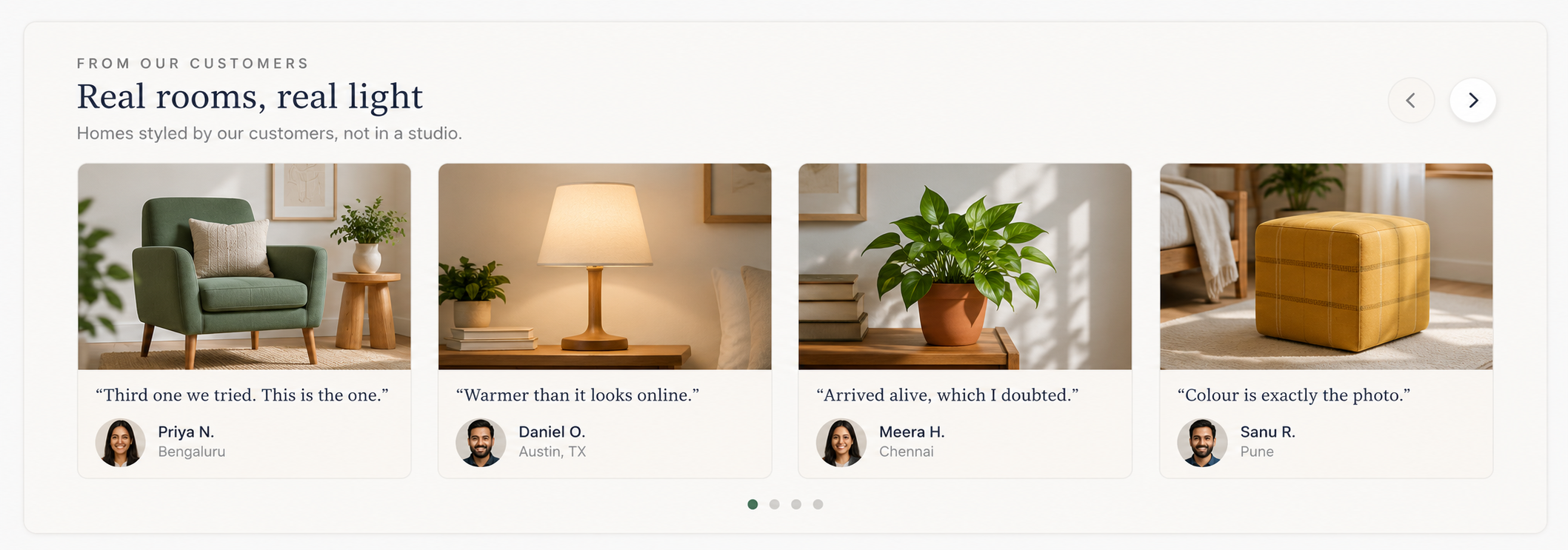
Harder to fabricate than a sentence, and shoppers read it that way.
Real customer images of the product in use, each with a short quote. Closer to social content than to a testimonial block, and the version shoppers respond to best.
Baymard’s DTC work found participants appreciated seeing real-life imagery of products from actual customers far more than they engaged with written reviews on the site. A photograph in a real room, with real light, is harder to fabricate than a sentence and is read that way.
Wins when
The product is visual and its appeal depends on context — apparel, furniture, décor, beauty, food. It also solves the “does it look like the photos?” doubt that studio imagery creates.
Fails when
The photos are obviously professional. A strip of studio shots labelled as customer photos is the fastest way to lose the trust the section was built to earn. It also fails when you use someone’s image without documented permission.
Costs you
Ongoing collection effort, plus permissions admin. This is the most operationally demanding pattern here.
2.6 The inline contextual quote
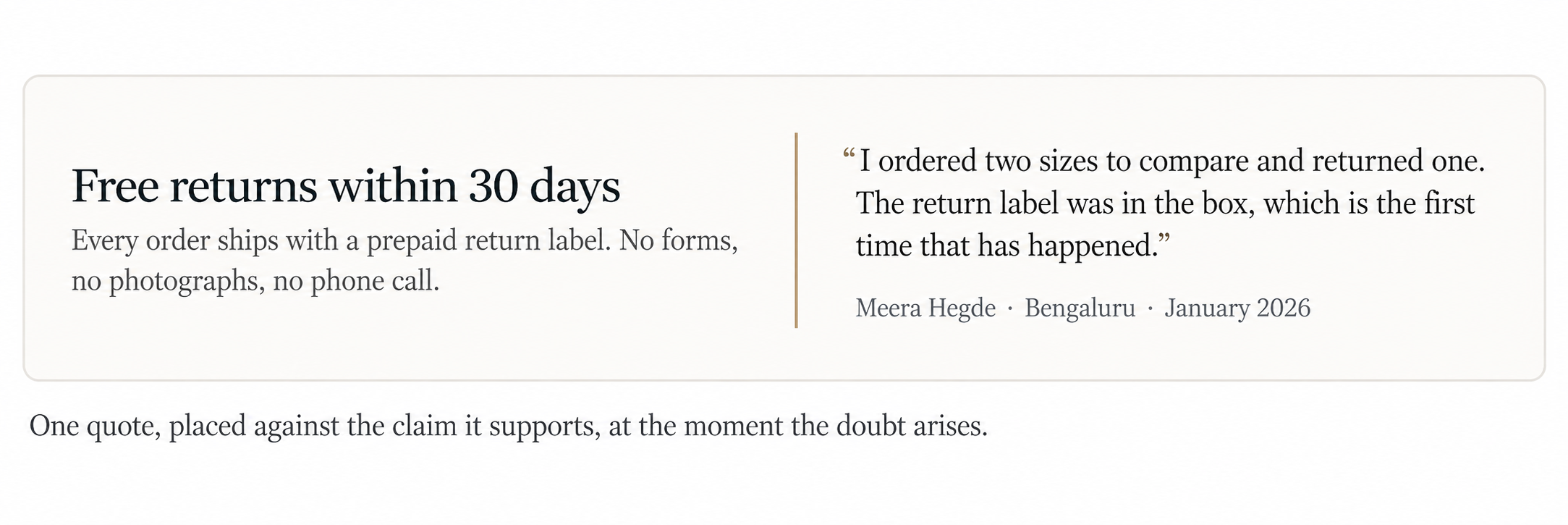
No dedicated section at all. A single short testimonial placed directly beside the claim it supports — a delivery quote next to the shipping promise, a sizing quote next to the size guide. The most under-used pattern on this list.
Wins when
You know which specific doubt stops people buying. A quote answering that doubt, at the moment it arises, does more than the same quote in a section further down that many visitors never reach.
Fails when
It is decorative. A quote that does not address the adjacent claim is just clutter in a place where the shopper was trying to read something.
Costs you
The volume signal entirely — there is no sense of how many people agree. Best used alongside one of the patterns above rather than instead of them.
Foundation · 2 min
3. Choosing your pattern
Start here, then read that pattern’s “fails when” line before committing
| If this is true | Start with | Because |
|---|---|---|
| Six-plus testimonials covering different objections | Quote wall | Volume and range are the argument; nothing is hidden |
| One genuinely strong, specific story | Featured single quote | One credible voice beats six vague ones |
| Real rating volume, ideally third-party | Rating summary with quotes | The count is more persuasive than the score |
| A visual product and real customer images | Customer photo strip | Harder to fabricate, and shoppers know it |
| You know the one doubt that stops people | Inline contextual quote | Answers the objection where it actually arises |
| Long testimonials and very little space | Rotating carousel | The only real case for it — and never auto-advancing |
| Fewer than three real testimonials | Build nothing yet | A thin section signals a new or unproven business louder than no section does |
Foundation · 2 min
4. What makes a testimonial believable
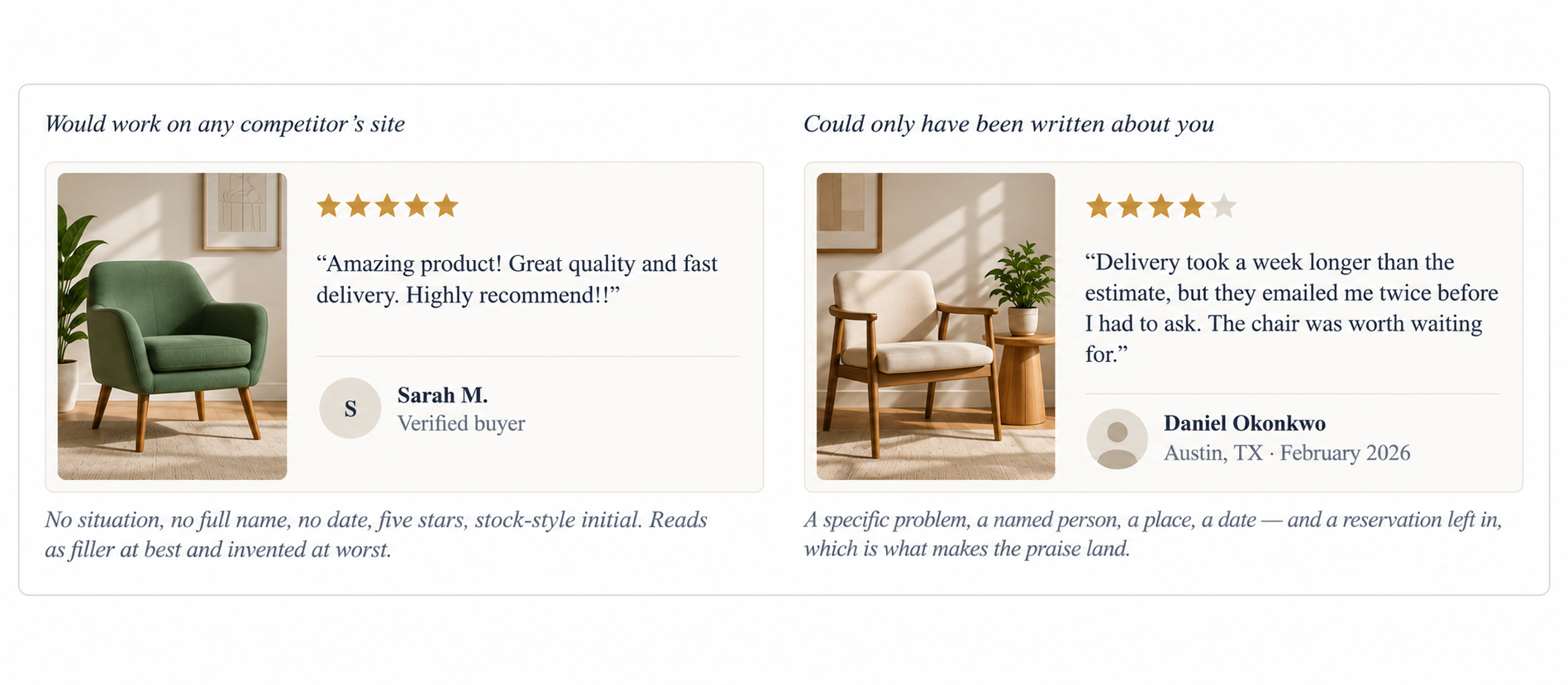
The difference is not writing quality. It is how much checkable detail a fabricator would have had to invent.
Credibility comes from detail a fabricator would not bother to invent. Six things separate a testimonial a shopper reads from one they skip.
- A specific situation, not a verdict. “The 8ft rug fitted our awkward narrow living room exactly — I measured three times and still expected to be wrong” is believable. “Great quality!” is not. Specificity is the single strongest credibility signal, and it costs nothing but the willingness to publish an unpolished sentence.
- Full attribution. A full name, a role or location, and a date. First-name-only attribution — “Sarah M., verified buyer” — reads as anonymised, which reads as invented. ZenBasket’s testimonial records carry a designation field alongside the name; it is the field most stores leave empty and the one that does the most work.
- A real face, or none. A genuine customer photograph helps. A stock portrait is worse than no image, because shoppers recognise stock photography and it retroactively discredits the quote attached to it.
- Imperfection left in. A testimonial that mentions a small reservation — “delivery took a week longer than I expected, but the piece was worth waiting for” — is substantially more believable than unbroken praise, and it pre-answers an objection.
- A verifiable trail where possible. Linking out to the same review on an independent platform converts an assertion into something checkable. It feels counterintuitive to send people away; it is the most direct answer to the 29% who leave anyway.
- A date. Undated testimonials are assumed old. A section where the newest quote is three years cold suggests the last happy customer was three years ago.
Two formatting rules follow. Keep quotes as real HTML text, never as images — the same accessibility, translation and crawlability reasons that apply to any other on-page text. And use proper semantics: a <blockquote> with a <cite> for attribution tells assistive technology, and answer engines, what they are looking at.
Foundation · 2 min
5. Testimonials or reviews?
These are different mechanisms and stores routinely build the wrong one. The distinction is who controls what appears.
| Testimonials | Reviews | |
|---|---|---|
| Who selects them | You do | Anyone who bought |
| Attached to | The brand | A specific product |
| Shopper’s assumption | Filtered | Representative, if the count is real |
| Best used for | Brand-level trust, service, the buying experience | Product-level decisions — fit, quality, accuracy |
| Answers | “Is this a real business worth dealing with?” | “Is this specific item right for me?” |
If a shopper’s hesitation is about the product, a testimonial section will not fix it. Reviews on the product page will. Testimonials earn their space on the homepage and about page, where the question is whether the business itself is credible — which is exactly where a first-time visitor’s doubt actually sits.
Running both is normal and correct. Running only testimonials, on a store that sells products people need to evaluate, usually means the review system was never set up. (Product reviews and store testimonials are separate features in ZenBasket.)
Foundation · 3 min
6. The rules you have to follow
Testimonials moved from a reputational risk to a regulated one. This is design guidance rather than legal advice, and you should confirm the current requirements for every market you sell into — but the direction of travel is not ambiguous.
United States
The Federal Trade Commission’s rule on consumer reviews and testimonials, finalised in August 2024 and effective sixty days after publication, prohibits six practices and allows the FTC to seek civil penalties against knowing violators. The ones that bear directly on a testimonial section:
- Fabricated testimonials, including AI-generated ones, or any that misrepresent the writer’s actual experience.
- Compensation conditioned on sentiment — you may not offer anything in exchange for a review expressing a particular view, positive or negative.
- Undisclosed insider testimonials — quotes from officers, managers, employees or their relatives must clearly disclose the connection.
- Suppression misrepresentation — implying the displayed testimonials represent all or most feedback received when negative feedback has been held back.
India
The Bureau of Indian Standards published IS 19000:2022, Online Consumer Reviews, in November 2022, covering how reviews are collected, moderated and published. It is voluntary rather than mandatory, with a conformity assessment scheme intended to follow. Its substance is close to the FTC’s: rewards for reviewing must not depend on what the review says, incentivised reviews must carry a visible mark identifying them as such, and platforms should not knowingly publish purchased reviews.
What this means for the section you build
- Keep the source record for every testimonial — where it came from, when, and the customer’s permission to publish it, including their name and image.
- Label anything incentivised, clearly and next to the quote, not in a footnote.
- Disclose any relationship. An employee’s testimonial is usable if the connection is stated.
- Do not imply completeness. “What our customers say” is safer than “All customer feedback”.
- Never generate a testimonial, and never lightly edit one into something the customer did not say. Trimming for length is normal; changing the meaning is not.
Foundation · 2 min
7. When a testimonial section is the wrong pattern
Social proof answers one doubt: do other people like this? It is rarely the only doubt, and three neighbouring patterns answer the others far better. A store that builds all four has a trust story; a store that builds four testimonial sections does not.
| If the real doubt is… | Use | Why not a testimonial section |
|---|---|---|
| “What happens if it doesn’t fit / arrives damaged / I change my mind?” | FAQ section design for ecommerce | That is a factual question with a factual answer. A quote saying returns were easy is weaker than the returns policy stated plainly |
| “Is this a real business I can contact?” | Footer design for ecommerce | Registered details, policies, contact routes and payment marks live in the footer, on every page — testimonials sit on one or two |
| “Where are you actually based?” | Store locator and map section design | A verifiable address on a map is the strongest trust signal a new brand can show, and no quote substitutes for it |
The ordering matters more than most teams assume. For an unfamiliar brand, is this real? comes before is this good? — so the footer and the address often do more work than the testimonials above them.
In ZenBasket, all three are built with dedicated features: expandable panels fed by your FAQ settings, footer customization, and the map element. Your hours and ordering rules are managed separately in Location settings.
Foundation · 2 min
8. What breaks testimonial sections
| Failure | How it shows up | Fix |
|---|---|---|
| Interchangeable quotes | Every testimonial would work on any competitor’s site | Replace with specific situations; publish the unpolished sentence |
| Anonymised attribution | “Sarah M.” and a stock portrait | Full name, designation, date — or drop the image entirely |
| Unbroken five stars | Perfect scores everywhere; shoppers read it as filtered | Show the distribution and the count; leave mild reservations in |
| Auto-rotating carousel | Quotes slide away mid-sentence; most visitors see one | Stop the auto-advance, or switch to a quote wall |
| Stale set | Newest testimonial is years old, or undated | Show dates; give the set an owner and a refresh cycle |
| Quotes as images | Unselectable, untranslatable, invisible to crawlers and assistants | Real HTML text in a blockquote with a cite |
| Undisclosed incentives | Gifted or employee testimonials shown as ordinary customers | Label them next to the quote — required in the US, expected in India |
Foundation · 2 min
9. Knowing whether yours works
Testimonial sections are hard to measure directly, because their effect is mostly preventing an exit rather than causing a click. Measure the absence of a problem.
- Exit rate from the pages carrying the section. The clearest proxy for the “left to research you” behaviour the research describes.
- Scroll-past rate. What share of visitors reach the section at all. Many testimonial sections sit below the point most sessions stop.
- Dwell time on the section versus the blocks around it. Quotes people genuinely read hold attention; filler is scrolled through at speed.
- Branded search volume after a visit. A rise in people searching your brand name plus “reviews” suggests the on-site section is not answering the question.
- Ask new customers what nearly stopped them. Five post-purchase replies will tell you more about which doubt to answer than any analytics view.
Before publishing:
- Every quote names something specific enough that it could only be about you
- Full name and designation on every testimonial; no stock portraits
- Dates visible, and the newest is recent
- Rating counts shown wherever a score is shown
- At least one mild reservation left in the set
- Incentivised or insider testimonials clearly labelled beside the quote
- Written permission on file for every name and image used
- Quotes are real HTML text in semantic blockquote markup
- No auto-advancing carousel; any motion respects reduced-motion
- Heading does not imply the set is complete feedback
- The section has an owner and a refresh cycle
Foundation · 3 min
10. Choosing a ZenBasket theme for trust and social proof
Everything above is platform-independent. If you are choosing or changing a ZenBasket theme, trust sections are a revealing thing to judge it on, because they are the blocks themes most often treat as decoration.
Judge a theme’s trust sections in five minutes
Open the theme’s demo store on a phone and check six things from this guide:
- Is the testimonial quote selectable text, or an image? Try to select it.
- Does the attribution block have room for a name and a designation and a date?
- Does the testimonial carousel auto-advance, and can you pause it?
- Is there a place to show a rating count next to a score, not just stars?
- Does the footer have room for real registered details, or only links?
- Is there an FAQ and a map section in the theme, or will you be building both from blank?
A theme failing one or two is fixable in the builder. A theme with no FAQ, no map and an image-based testimonial block means building the entire trust layer yourself.
Thinking about it as a bundle rather than a section
The four trust patterns — testimonials, FAQ, footer and store locator — work as a set, and it is worth planning them together rather than adding each when someone notices it is missing. A practical order for a new store: get the footer right first because it appears on every page, then the FAQ because it removes support load as well as doubt, then the map if you have a physical presence, and testimonials last, once you actually have some worth showing.
Browse the range on the ZenBasket themes collection, where each theme has a live demo store you can open on your own phone. Free themes support every pattern in this guide when the section is built on a blank section; premium themes earn their place when you want the native sections around them individually styled to match.
You can apply a premium theme and customise it in the builder before buying it; you simply cannot publish it live until it is purchased. Note that Replace Current Theme swaps your existing design, layout and settings for the new theme’s defaults, while Keep Existing Theme cancels the switch.
Foundation · 2 min
11. Building it in ZenBasket
Step zero happens outside the builder. Testimonials are records in your store, not text typed into a section. Each one carries a customer name, designation, feedback, rating, image and publish status, and you can filter by status, rating and date or import them in bulk — which is also where you keep the set current and control what is live. (Store testimonials.) Because the section is data-driven, publishing and unpublishing a testimonial changes the storefront without touching the design.
Pattern to element
| Pattern | How it is built |
|---|---|
| Quote wall | A data-driven slider mapped to testimonials, set to show all cards without scrolling |
| Rotating carousel | The content rotator — leave autoplay off |
| Featured single quote | A blank section with heading, quote and attribution elements — see customizing sections |
| Rating summary with quotes | Testimonial mapping plus the rating element, with the aggregate built alongside |
| Customer photo strip | Image elements in a row or slider, each with a short caption over a scrim |
| Inline contextual quote | A quote element placed inside the section carrying the claim it supports |
Start from adding a new section and choose a blank section, then map the testimonial data and style the card. Effects and animations handles a fade-in on the cards — keep it subtle, since motion on a trust block reads as marketing.
One builder behaviour worth knowing: deleting an element in the desktop view does not delete it in the mobile view, and font sizes changed in the property box are device-specific while those changed from the floating toolbar apply to both. Testimonial cards are where long quotes most often break the mobile layout, so check that view before publishing.
Foundation · 5 min
12. Frequently asked questions
What is a testimonial section on an ecommerce site?
A block, usually on the homepage or about page, showing customer quotes the brand has selected. It differs from product reviews in that you choose what appears, which is exactly why shoppers discount it. Its realistic job is to give a sceptical visitor enough checkable detail that they do not leave to research you elsewhere.
Do customer testimonials actually work?
Less than most stores assume, for brands the shopper does not already know. Baymard’s DTC research found 62% of shoppers said they would research an unfamiliar brand elsewhere, and 29% left the site during testing to do so, because they assume on-site feedback has been curated. Testimonials help when they are specific, fully attributed and checkable — not when they are numerous and glowing.
How many testimonials should I show?
Three to six visible at once is the useful range for a quote wall. Below three the section signals a new or unproven business more loudly than no section would. Above six, people stop reading and start pattern-matching, and repetition begins to read as selection rather than consensus.
What makes a testimonial credible?
Detail a fabricator would not bother to invent: a specific situation rather than a verdict, a full name with a role or location, a date, a real photograph or none at all, and ideally a link to the same feedback on an independent platform. A small reservation left in the quote makes it more believable, not less.
Should I use a carousel for testimonials?
Only when the quotes are long and space is genuinely tight, and never on auto-advance. A quote that slides away mid-sentence is worse than no quote, and auto-rotation means most visitors see exactly one testimonial — so you have built a single-quote section with extra engineering. A quote wall is usually better.
What is the difference between testimonials and reviews?
You select testimonials; anyone who bought can leave a review. Testimonials attach to the brand and answer “is this a real business worth dealing with?”. Reviews attach to a product and answer “is this specific item right for me?”. If the hesitation is about the product, a testimonial section will not fix it — reviews on the product page will.
Is it legal to edit a customer testimonial?
Trimming for length is normal practice; changing the meaning is not. In the US the FTC’s 2024 rule prohibits testimonials that misrepresent the writer’s actual experience, and allows civil penalties against knowing violators. Keep the original wording on file, and confirm current requirements for every market you sell into — this is design guidance, not legal advice.
Do I have to disclose incentivised or employee testimonials?
Yes. The FTC rule bars compensation conditioned on a particular sentiment and requires disclosure of testimonials from officers, managers, employees and their relatives. India’s voluntary BIS standard IS 19000:2022 takes a similar line, asking that incentivised reviews carry a visible mark. Put the disclosure beside the quote, not in a footnote.
Should I show a perfect five-star rating?
Not if it comes from a handful of ratings. Baymard found nearly twice as many people preferred a 4.5 average from 57 users over a 5.0 from four — a perfect score from a tiny sample reads as meaningless or suspicious. Always show the count beside the score, and show the distribution including the low rows.
Where should the testimonial section go on the page?
Below the product and category content, not above it — a first-time visitor wants to know what you sell before they care who liked it. On the homepage it works well immediately before the footer, where it supports the “is this real?” question the footer answers factually. Check your scroll data: many testimonial sections sit below the point most sessions stop.
Can I use customer photos in a testimonial section?
Yes, and shoppers respond to them better than to written quotes, because a photograph in a real room is harder to fabricate. Two conditions: get documented permission to publish the image, and do not mix studio shots into a strip labelled as customer photos — that is recognised quickly and discredits the whole section.
How often should testimonials be updated?
Often enough that the newest one is recent — quarterly for most stores. Undated testimonials are assumed old, and a set whose latest entry is years cold suggests the last satisfied customer was years ago. Since testimonials are records you can publish and unpublish, refreshing the set does not require touching the design.
Foundation · 2 min
13. Where to go next
- FAQ section design for ecommerce — answering factual doubt, and removing support load
- Footer design for ecommerce — the trust signals that belong on every page
- Store locator and map section design — physical presence as proof
- Product detail page guide — reviews and ratings where product doubt actually sits
- Proven Pattern Library — the rest of the pattern set