Foundation · 2 min
What Makes a Handmade Store Work
A handmade store is designed around one question a shopper cannot answer alone: is this really made by hand, and is it worth the price? Tell them who makes it and how, in your own words. Describe the materials and the process plainly, and say honestly that no two pieces are identical. Photograph texture and scale rather than styling alone. Then be clear about the three things that decide whether a first-time buyer trusts you: how long it takes to make, when it will arrive, and how many are left.
Foundation · 2 min
1. Why handmade stores are designed differently
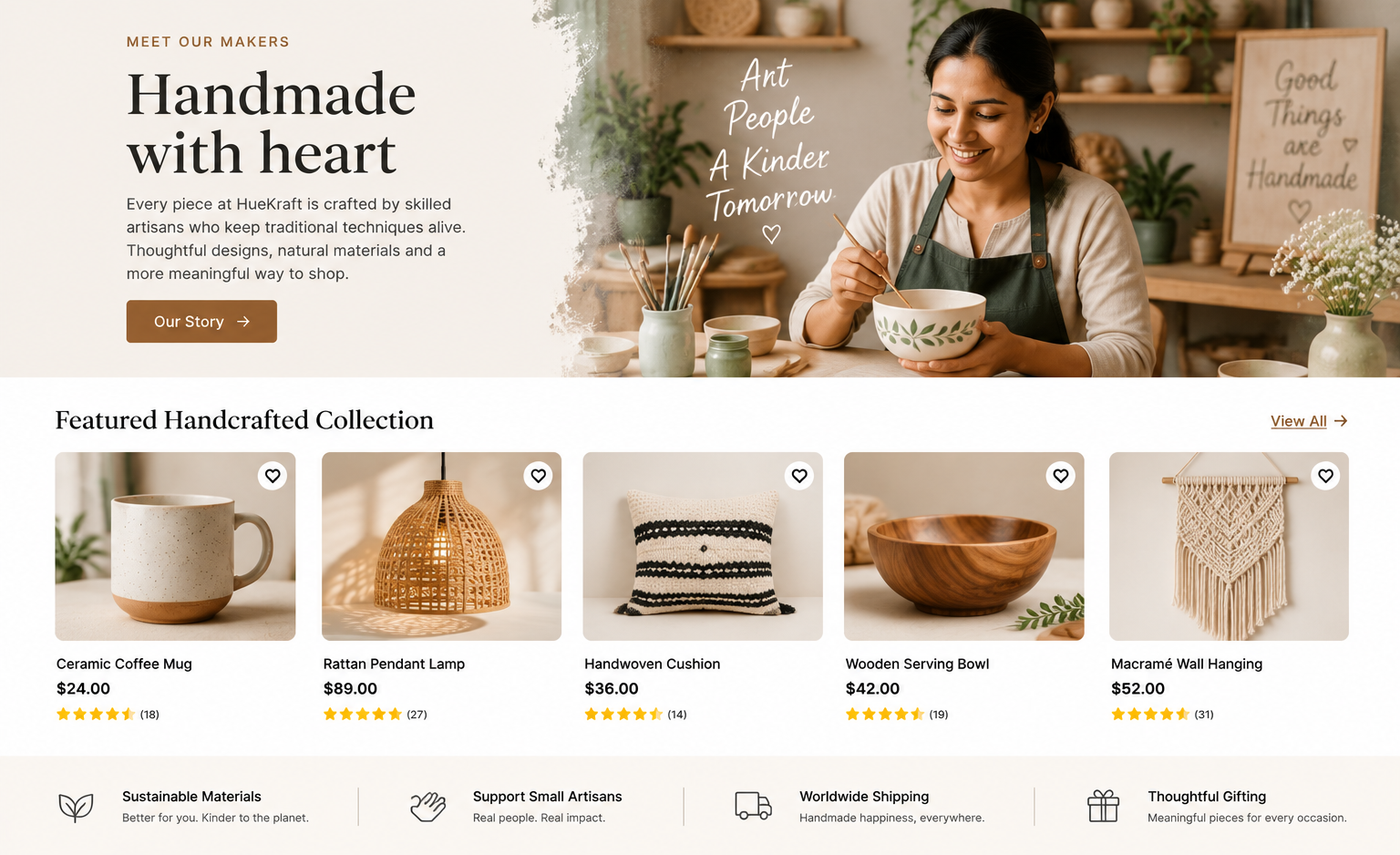
Handmade shoppers are buying the maker as much as the object. They are paying more than a factory price on purpose, and they want to know why it costs what it costs and who benefits. They also have to accept something no other category asks of them: the piece that arrives will not be identical to the photograph. Four consequences shape everything below.
| The difference | What it does to your store |
|---|---|
| The maker is part of the product | Your story is not an About page afterthought. It belongs where people are deciding, and in your own voice. |
| No two pieces are identical | Variation has to be promised up front, or it arrives as a complaint instead of a feature. |
| Things take time to make | Production time is a product detail, not a shipping detail, and it belongs beside the price. |
| Stock is tiny and often one of a kind | Availability changes the whole page. Sold out is normal, and how you handle it decides whether the visit is wasted. |
One claim worth arguing with: for a handmade store, honesty converts better than polish. A plain page that says the piece takes three weeks, varies slightly and is made by two people in a small studio will outsell a glossy page that hides all three. Customers who want factory-perfect and next-day delivery are not your customers, and pretending otherwise produces refunds.
Foundation · 2 min
2. Maker story
The story is what separates your ₹1,200 candle from a supermarket one. It has to be visible while people are choosing, not hidden behind an About link.
- Say who makes the work, where, and how long you have been doing it. Two or three honest sentences beat a page of brand language.
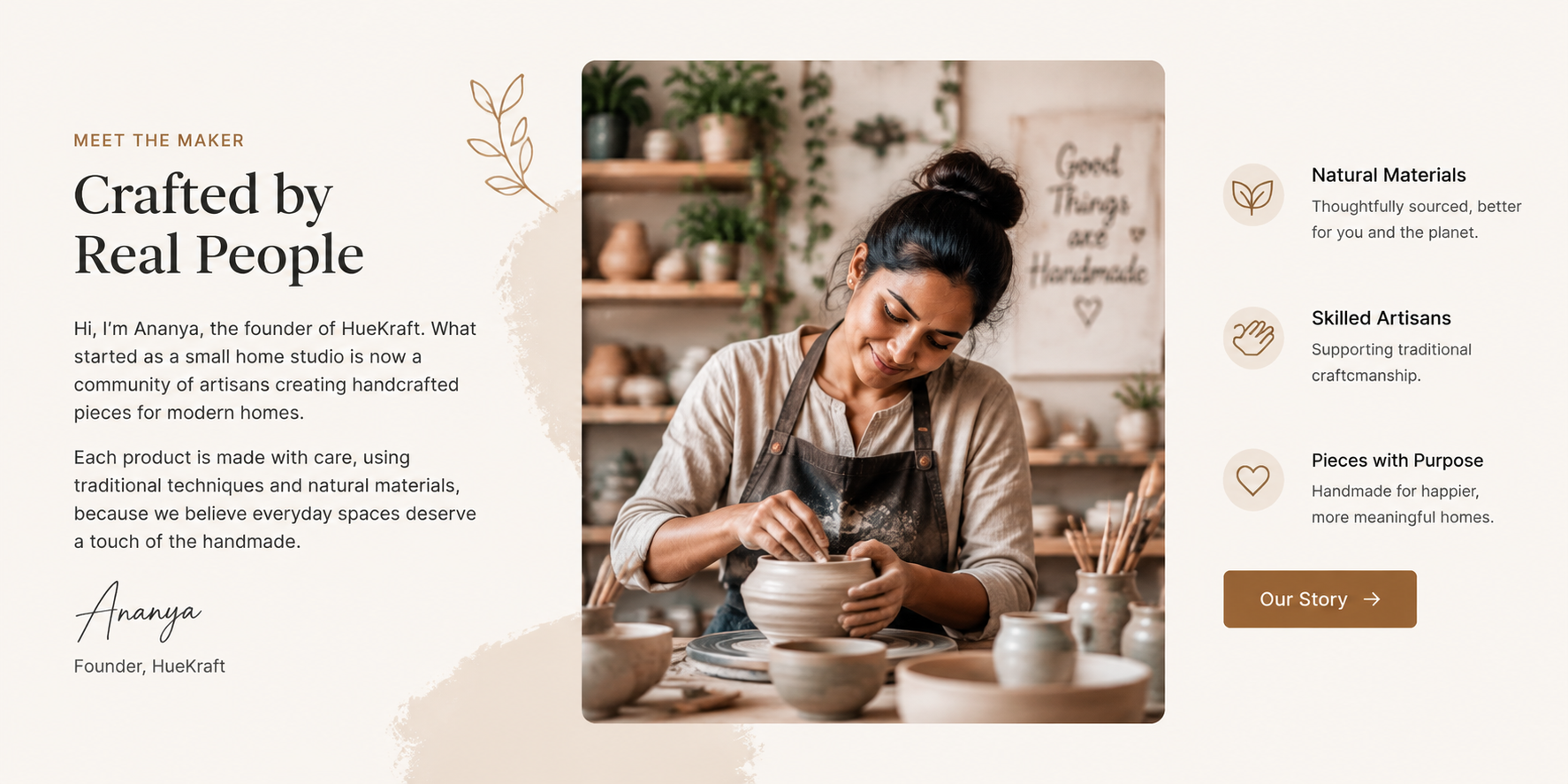
- Show your face, your hands or your workspace. A real photograph of a person working does more for trust than any badge or claim.
- Put a short version on the product page and the full version on its own page. The short version is what most people read.
- Write in your own voice, in the first person. “I make these in my kitchen in Coimbatore” is more persuasive than “our artisans craft each piece with passion”.
- If you work with a group of makers or a co-operative, say so, and say how the money is shared. Customers increasingly ask.
- Keep it current. A story that still says “launching soon” two years later undoes the trust it was meant to build.
The full story works as its own page built with images and text placed side by side in the same section, and your studio shown on a map if customers can visit.
Foundation · 2 min
3. Materials and process
This is where the price is justified. A shopper comparing your piece with a mass-produced one needs to see what it is made of and what went into making it.
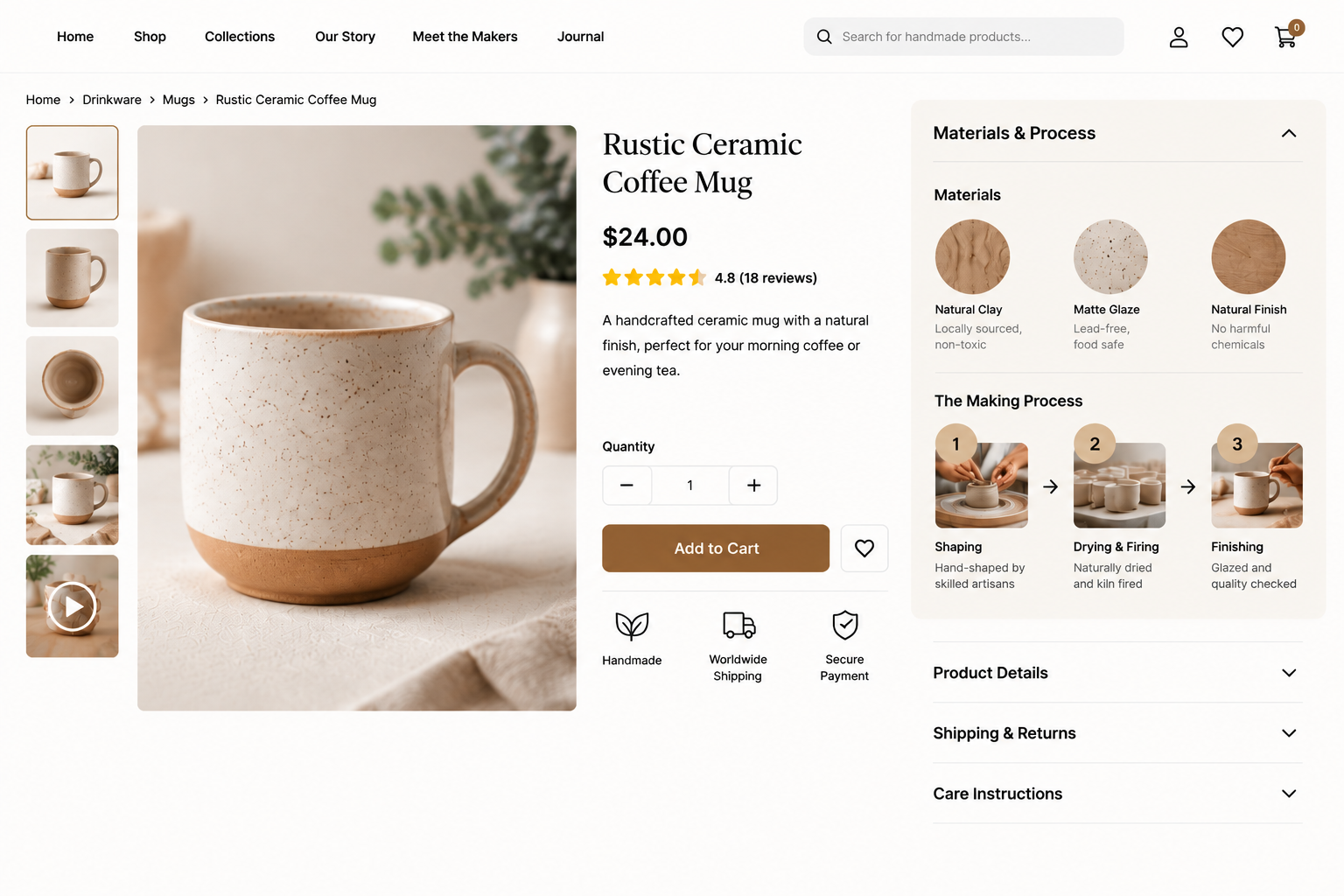
- List the materials plainly — the clay, the wood, the yarn, the wax, the oils — and where they come from if that matters to your customers.
- Describe the process in a few steps, in normal words. Thrown on a wheel, dried for a week, glazed and fired twice. People enjoy reading this and it explains the cost without you having to defend it.
- Say how long each piece takes to make. It is the single most effective line on a handmade product page.
- Where a technique has a name people search for — block printing, hand-thrown, lost-wax casting — use it, and explain it in one line for those who do not know it.
- Say what is handmade and what is not. If the base is bought in and you decorate it, say so. Customers forgive honesty and punish discovery.
Write all of this as text rather than putting it inside a graphic. It is exactly the content people search for, and a picture of words cannot be found or read aloud.
Materials and process sit well in switchable panels or an expandable panel on the product page, with a short video of the work in progress where you have one.
Foundation · 2 min
4. Product uniqueness
Variation is the point of handmade work, but only if the customer knows about it before they buy. The same difference that delights one shopper feels like a defect to another who was not warned.
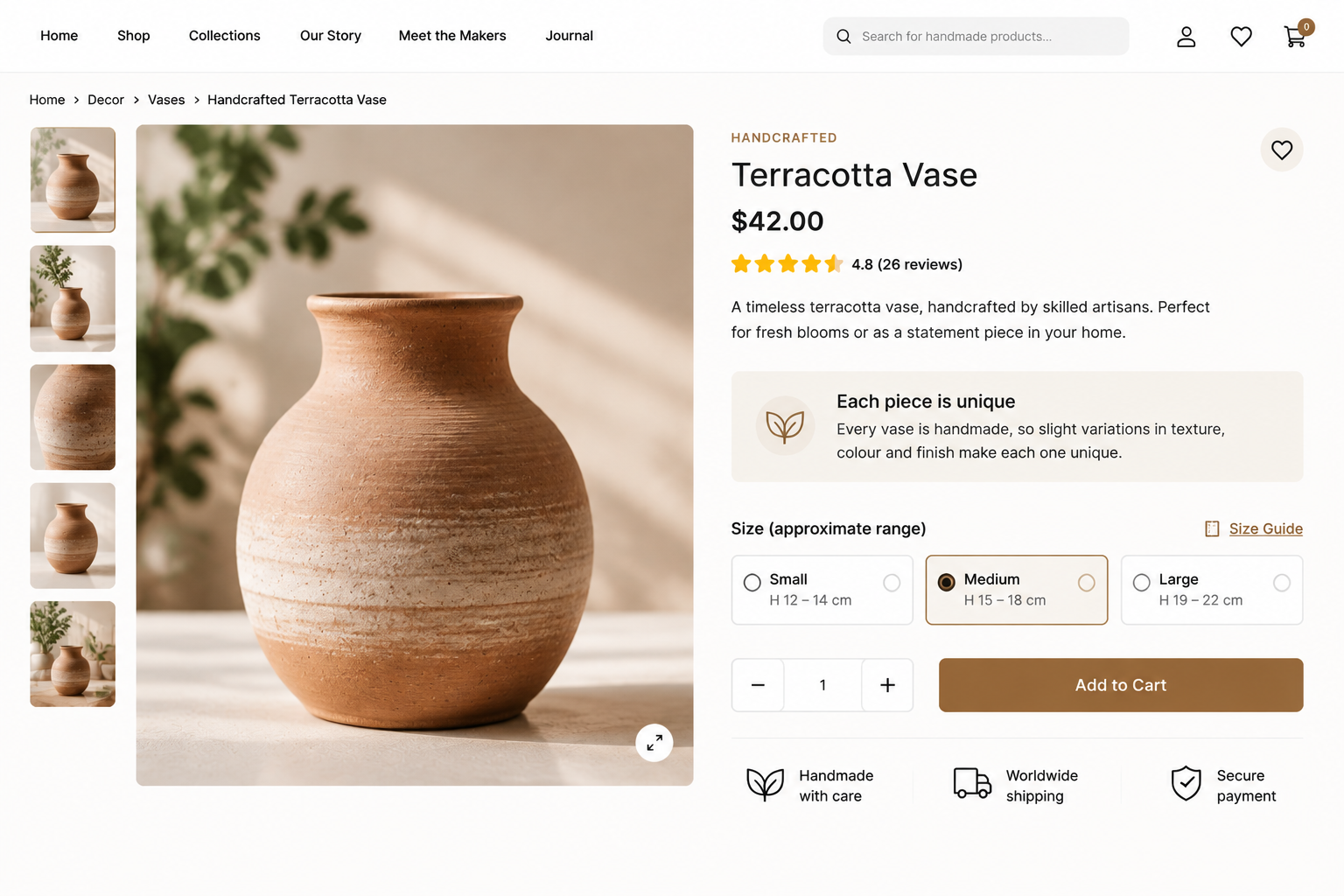
- Say plainly that each piece varies, and say how: colour, grain, size within a millimetre or two, the position of a pattern.
- Give the range rather than a single figure. “Between 8 and 9 cm tall” is honest; “9 cm” invites a complaint about the one that came out at 8.5.
- Where a piece is genuinely one of a kind, label it clearly and say that the photograph is of the actual item being sold. That is a selling point, so do not bury it.
- Where you make a batch, say the photograph is representative and the piece will be similar but not identical.
- Explain the marks that are part of the process — a thumbprint in the glaze, a slub in hand-spun yarn, a tool mark — and why they are not faults.
- Keep the promise in the returns policy too. If variation is expected, saying so in both places prevents an argument later.
A one-of-a-kind or made-to-order mark on the listing tile can be handled with product badges, and the variation note belongs in the product description rather than in the returns page alone.
Foundation · 2 min
5. Customisation
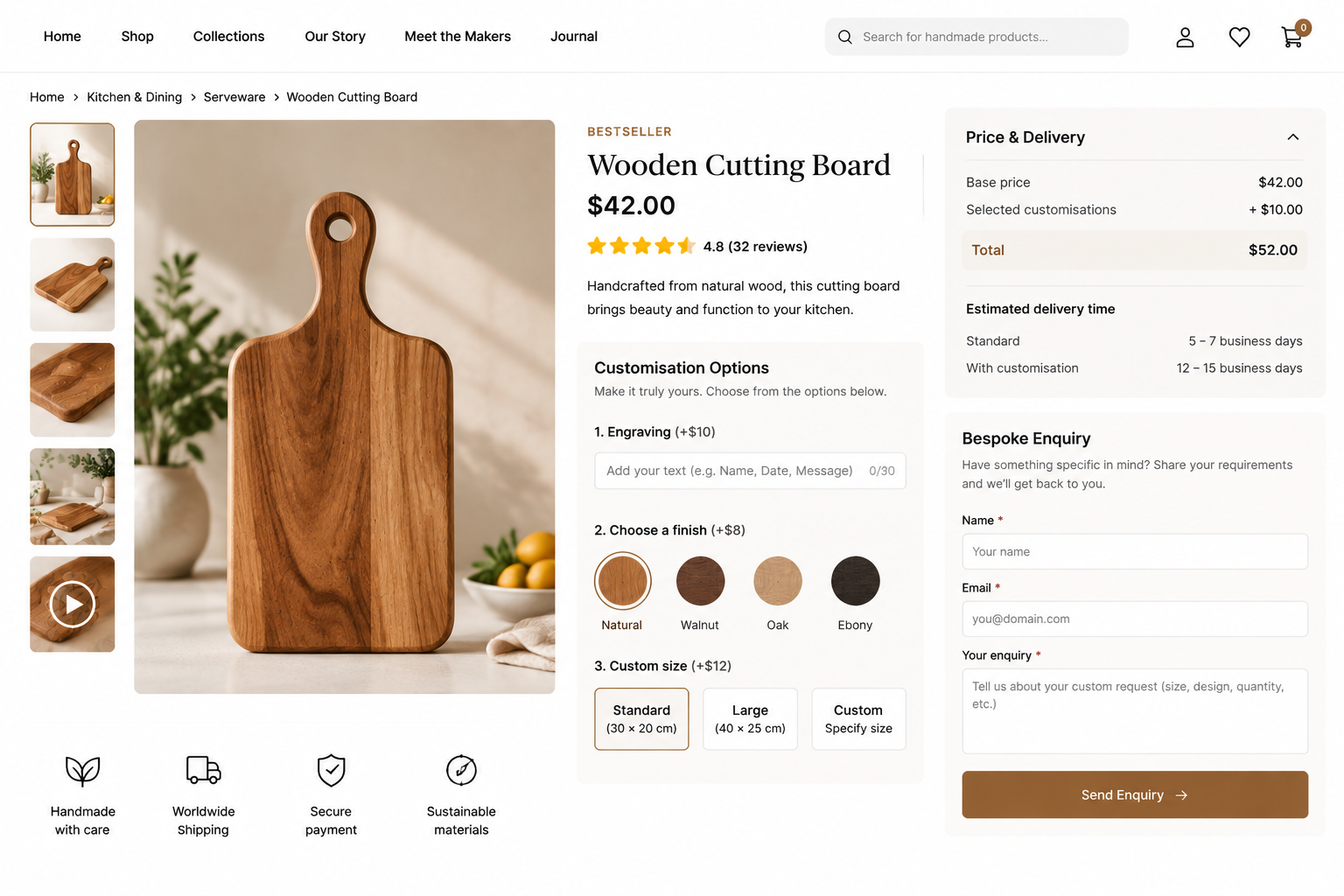
Being able to change something is one of the real advantages a maker has over a factory. The design job is to keep it simple enough that the customer knows exactly what they are getting.
- Offer a small number of clear choices — colour, size, wood, engraving — rather than an open-ended “tell us what you want” on every product.
- Show the price difference on each choice, and how it changes the making time. A customisation that adds two weeks needs to say so where it is chosen.
- Where the customer types something, such as a name or a date, show it back to them before they pay, and state the character limit and the spelling rules.
- Always put a text label beside a colour or material swatch. A row of coloured circles is unreadable to anyone who cannot tell them apart.
- Say whether a personalised item can be returned. In most places it cannot, and that has to be said before purchase rather than after.
- For fully bespoke work, replace the buy button with an enquiry form. Ask for a budget range, a rough idea and a deadline, and say how fast you reply.
Fixed choices are set up as product options, and bespoke enquiries work best as a short form on its own commissions page.
Foundation · 2 min
6. Production time
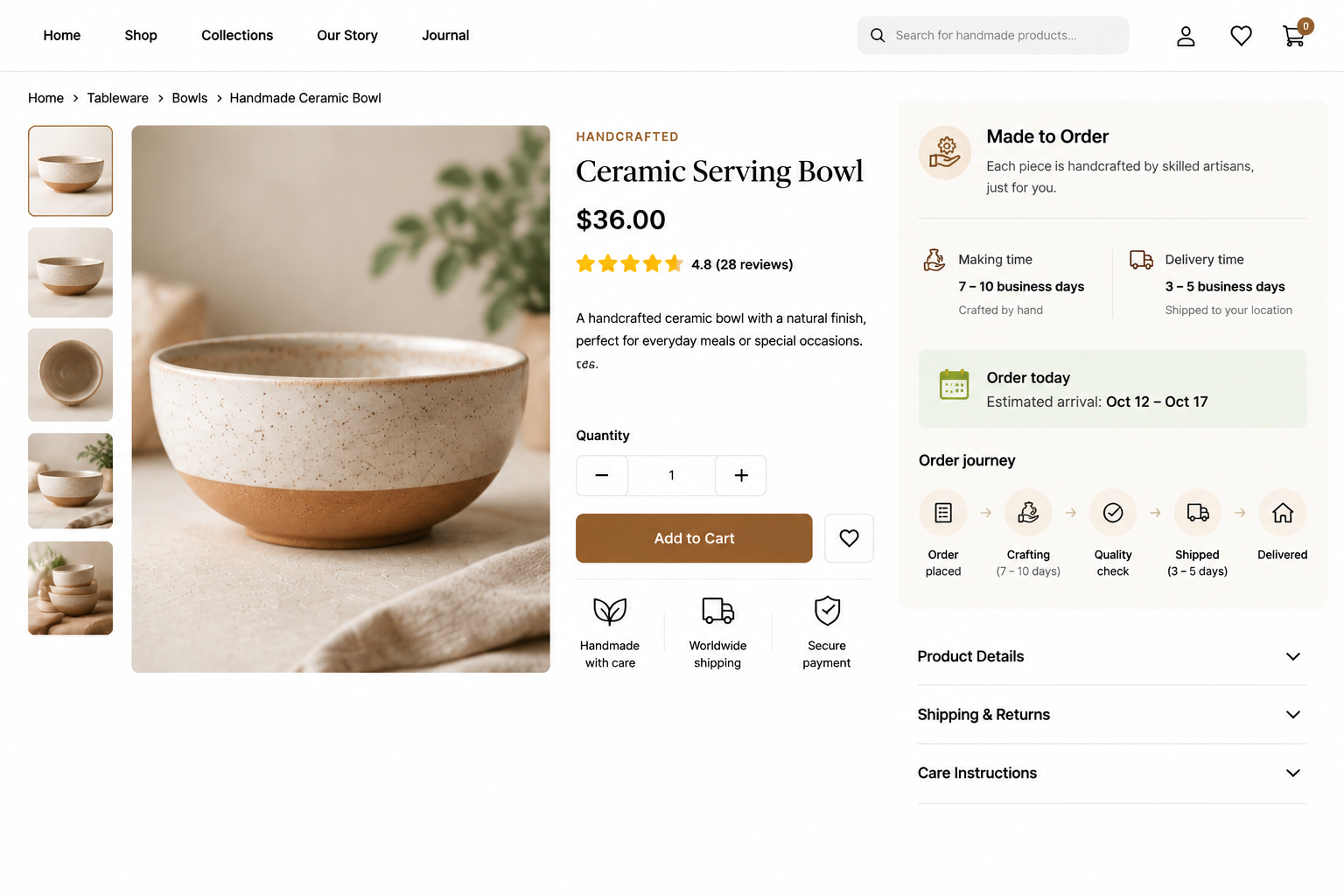
In handmade, making time and delivery time are two different things, and confusing them is the commonest cause of an unhappy first order. Show them separately.
- Label every product as ready to ship or made to order. It is the first thing a customer needs to know and it changes what they expect.
- For made-to-order work, give the making time in days or weeks, then the delivery time on top, and show the two added together as an estimated arrival.
- Update the time when you get busy. A three-week queue advertised as one week is worse than no estimate at all.
- Say what happens for gifts and deadlines, and put a cut-off date on the page before festivals and wedding season rather than answering it one message at a time.
- Send a note when the piece starts and when it ships. A photograph of the work in progress costs nothing and buys a lot of patience.
- If you close the studio for a holiday, say so on the site before orders arrive, not after.
 Hand-thrown Stoneware Mug  ·  Made to order

  Each piece varies slightly — 8–9 cm tall, glaze pools differently
  Materials  Local stoneware clay · food-safe glaze · fired twice

  Made in 10–14 days  +  delivery 3–5 days
  Estimated arrival: 29 Sep – 5 Oct

  Glaze  ( Ash )  ( Indigo )  ( Rust +₹150, adds 1 week )
  Only 2 left in this glaze
Making time, delivery time and variation, answered before the customer has to ask.
Made-to-order pieces can be sold as pre-orders with the lead time stated, and studio closures or festival cut-offs announced with an attention banner.
Foundation · 2 min
7. Photography
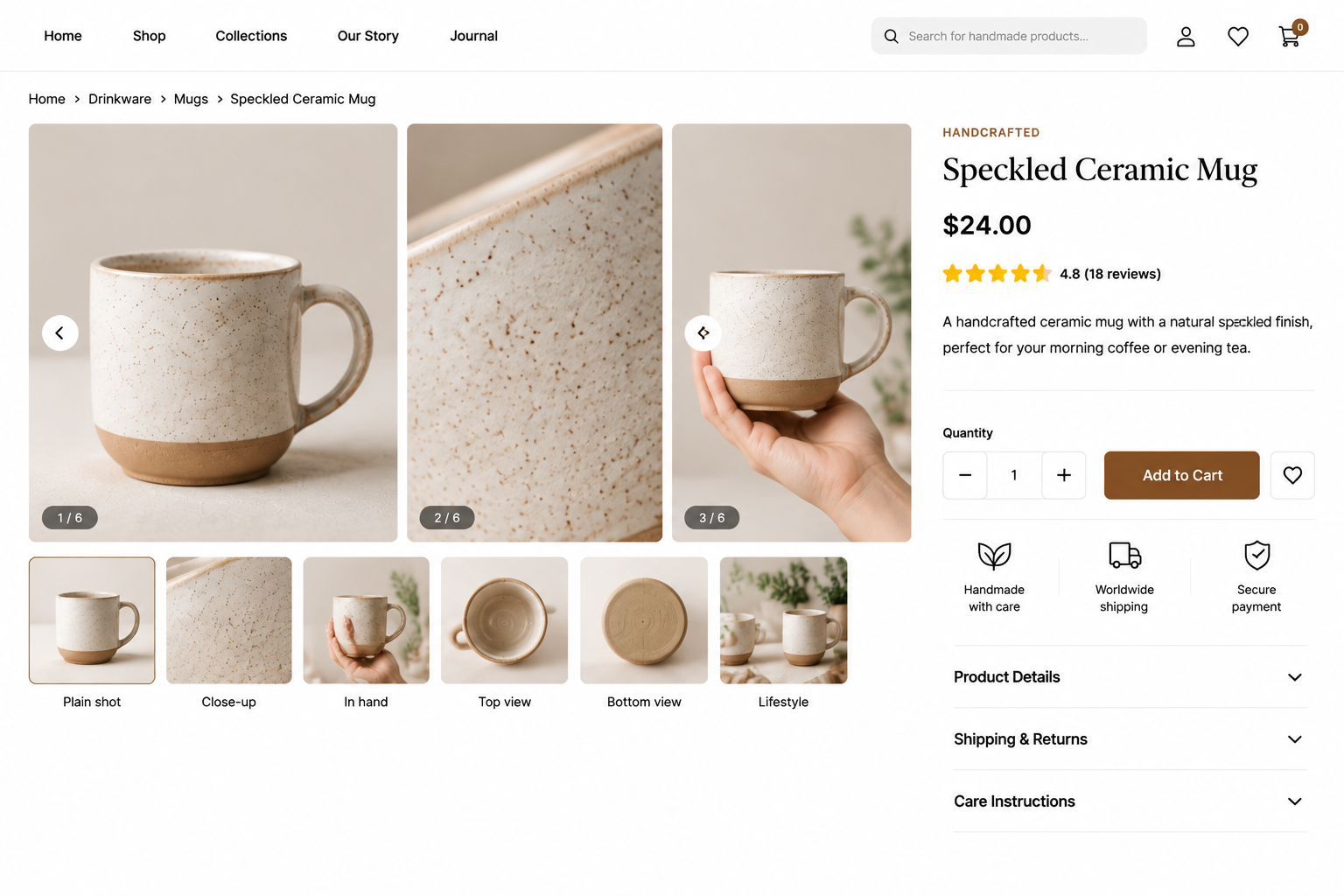
Handmade photography has a different job from catalogue photography. It has to show texture, scale and the evidence of a hand at work, which is exactly what a flat studio shot removes.
- Shoot a clean shot on a plain background so colour and shape are honest, then get close enough to see the surface — the glaze, the weave, the grain, the brush marks.
- Show the piece in a hand or beside something familiar. Scale is the commonest disappointment in this category and a photograph alone rarely conveys it.
- Include one photograph of the piece being made or the workspace. It supports the maker story without needing any words.
- Keep light and background consistent across the catalogue so the listing page looks like one shop rather than a market stall.
- Photograph honestly. Heavy editing that removes the marks of the hand is working against the thing you are selling, and it makes the arriving piece a letdown.
- For batch-made items, use a photograph that represents the middle of the range rather than the best one you ever made.
Large photographs are also why craft stores feel slow. Export images at the size they are displayed rather than uploading the full camera file, set the width and height so the page does not jump while they load, and let the gallery load the rest only as the shopper moves through it. The first image still needs to be sharp — it is the one people judge you on.
Galleries are built with the image element and a slider, with gallery layout set in the product details page settings. Styled photographs can be made shoppable with a hotspot.
Foundation · 2 min
8. Shipping expectations
Most handmade goods are fragile, posted by one person rather than a warehouse, and often sent abroad. Saying how you handle that removes the worry, and it manages expectations that a marketplace has set unrealistically high.
- Give a dispatch time and a delivery estimate separately, and remember dispatch starts after the making time, not after the order.
- Say how the piece is packed and protected. For anything breakable, this is a genuine selling point.
- Provide tracking, and say what to do if a parcel is delayed or arrives damaged. A photograph of the damage and a replacement or refund, stated plainly, is enough.
- For international orders, say who pays customs duty and that border delays are outside your control.
- Be honest that you are a small studio. “Posted every Tuesday and Friday” is a perfectly good promise, and it is better than pretending to dispatch daily.
- Say whether packaging is plastic-free or recycled if it is. Handmade buyers care, and it is a real difference rather than a slogan.
Dispatch days and festival cut-offs can be carried by an attention banner, the detail in a panel on the product page, and policies in the footer.
Foundation · 2 min
9. Limited inventory
A handmade store runs on tiny numbers. One of everything, or six of something, or a batch that appears once a season. That changes how the store should behave when something runs out.
- Show the real number when it is low. “Only 2 left” is honest here in a way it rarely is elsewhere, because it is true.
- Never let a sold-out piece be added to the basket. With one-of-a-kind work this is not an inconvenience; it is an order you cannot fulfil.
- Keep sold pieces visible rather than deleting them, marked as sold, with a link to something similar or to a made-to-order version. A sold-out page still shows what you can do.
- Let people ask to be told when something returns, and tell them when it does.
- For seasonal batches and drops, announce the date in advance and let people sign up rather than refreshing the page.
- Keep stock numbers accurate across your market stall, your social selling and your website. Selling the same piece twice is the fastest way to lose a customer you had already won.
Restock demand is captured with the waiting list, a drop can be counted down with a timer set to a real date, and low-stock display is a setting on the product details page.
Foundation · 2 min
10. Choosing a ZenBasket theme for your handmade store
Everything above is platform-independent. If you are building on ZenBasket, start from the themes mapped to arts and handicrafts. From the ZenBasket theme collection; current pricing is on that page.
| If you sell | Start with | Why |
|---|---|---|
| Craft, ceramics, textiles and small-batch work | HueKraft (free) | The mapped craft theme: room for the maker story, large detail photography and a small catalogue that still looks full. |
| Art, supplies and a wider styled range | Brushvia (premium) | More section types for collections, editorial content and campaigns. Documented in the Brushvia theme guide. |
| Handmade gifts, hampers and wedding favours | Bouqiva or ShaadiVex (premium) | Gift and wedding themes, where occasions and lead times matter more than browsing a catalogue. |
How to judge a handmade theme in ten minutes
Open the live demo on your phone, not your laptop:
- Is there an obvious place for the maker story on the homepage, above the products?
- Does the gallery hold several images and open large enough to show texture?
- Is there room near the price for making time, variation and stock?
- Can a product carry a few clear options with different prices?
- Is there a sensible place for a commissions or enquiry form?
- Does the layout still look right with only eight or ten products in it?
That last one matters more here than in any other category, because most handmade stores start with a handful of products. A theme that needs forty products to look finished will make a real studio look empty. You can apply and customise a paid theme to try it before buying, although it cannot be published live until it is purchased — see customising site themes.
Foundation · 2 min
11. Building it in ZenBasket
Sections you design yourself — a maker introduction, a process strip, a commissions block — are added to a blank section and filled with elements from the left panel. The pages the store already provides, such as the product page, the listing page and the cart, are edited in place by double-clicking the section. Product data itself — options, prices, stock and lead times — is managed in the catalogue, and the storefront reads from it.
| What this guide asks for | What to use |
|---|---|
| Maker introduction on the homepage | A blank section with an image and text side by side |
| Raw material next to the finished piece | Split view (drag-to-compare before and after) |
| Full story, commissions and care pages | Add a page, then add sections |
| Materials, process and care content | Switchable panels or expandable panels |
| Work-in-progress video | Video or advanced video |
| Detail gallery showing texture and scale | Slider and product details page settings |
| Colour, size and engraving choices | Product options and variants |
| Bespoke enquiries | Forms |
| Made-to-order pieces and drops | Pre-order and timer |
| Sold-out pieces and restock interest | Waiting list |
| One-of-a-kind and made-to-order marks | Product badges |
| Dispatch days and festival cut-offs | Attention banners |
| Studio location and market dates | Map element |
| Instagram and community content | Social media |
| Shoppable styled photographs | Hotspot |
| Logos, colours and typography | Customising site themes and store assets |
New to the builder? Start with Getting started, then adding sections and customising them.
Foundation · 4 min
12. Frequently asked questions
How do I design an online handmade store?
Put the maker story where people are deciding, describe materials and process in plain words, promise variation up front, photograph texture and scale, and state making time, delivery time and how many are left.
Where should the maker story go?
A short version on the homepage and on product pages, and the full version on its own page. Most people read the short one, so it has to carry the essentials.
Do I need to show my face?
It helps more than anything else on the page. A real photograph of you, your hands or your workspace does more for trust than any wording about craftsmanship.
How much should I explain about the process?
A few steps in normal words, plus how long a piece takes to make. It explains the price without you having to defend it, and people enjoy reading it.
How do I handle the fact that pieces vary?
Say so before purchase, describe how they vary, and give sizes as a range. Variation that is promised is a feature; variation that is discovered is a complaint.
Should I say a photograph is of the actual item?
Yes, when it is. For one-of-a-kind work that is a strong selling point. For batch work, say the photograph is representative and the piece will be similar but not identical.
How should customisation be offered?
As a few clear choices with their prices and any extra making time shown. Keep fully bespoke work behind a short enquiry form rather than a buy button.
Can personalised items be returned?
Usually not, but the rule has to be stated before purchase, on the product page, and confirmed when the customer types their personalisation.
How do I show production time?
Label the product ready to ship or made to order, give the making time, add the delivery time, and show the two together as an estimated arrival date.
What should I do when I get busy?
Update the making time on the site straight away. A queue advertised as shorter than it is causes more damage than a long but honest estimate.
What photographs does a handmade product need?
A plain shot for true colour and shape, a close-up of the surface or texture, and a shot showing scale — usually the piece in a hand. A work-in-progress shot helps too.
Should I edit my photographs heavily?
No. Editing out the marks of the hand works against what you are selling and makes the arriving piece a disappointment.
What should I say about shipping?
The dispatch days, how the piece is packed, tracking, what happens if it arrives damaged, and who pays customs duty on international orders.
How should sold-out pieces be handled?
Keep the page live, mark it sold, and offer something similar, a made-to-order version, or a way to be told when more are made. Never let a sold piece be added to a basket.
Is “only 2 left” a fair thing to show?
In handmade, yes, when it is true. Small real numbers are useful information here, unlike invented countdowns in other categories.