Foundation · 2 min
What Makes a Jewellery Store Work
A jewellery store is designed around two questions a shopper cannot answer alone: is this real, and how big is it really? Photograph every piece close enough to see the finish and worn so the size reads, and let people zoom until they are satisfied. State the metal, the purity and the stone details in plain words, and show the hallmark and any certificate. Help people choose a size before they buy, break the price down so nothing looks hidden, and be clear about secure, insured delivery. Where the piece is expensive or made to order, offer a conversation.
Foundation · 2 min
1. Why jewellery stores are designed differently
Jewellery is bought rarely, costs a lot, and is often bought for someone else. Shoppers cannot hold the piece, cannot judge its size from a photograph, and cannot tell from a screen whether the gold is what you say it is. Most of them are also nervous about paying a large amount to a store they have not used before. Four consequences shape everything below.
| The difference | What it does to your store |
|---|---|
| Scale cannot be judged from a photograph | Every piece needs a worn shot and real measurements, or the parcel disappoints when it arrives. |
| Authenticity has to be proved, not claimed | Hallmark, purity and certificates become part of the product page rather than fine print. |
| The price is built from several parts | Metal, making and stones all move. A single number with no breakdown reads as something to haggle over. |
| The purchase is high value and often a gift | Security, insured delivery and someone to talk to matter as much as the design does. |
One claim worth arguing with: in jewellery, proof sells better than romance. Beautiful campaign photography gets attention, but the hallmark, the weight, the certificate and the price breakdown are what turn a browser into a buyer. Spend on macro photography and honest product data before spending on a bigger campaign.
Foundation · 2 min
2. Detailed media
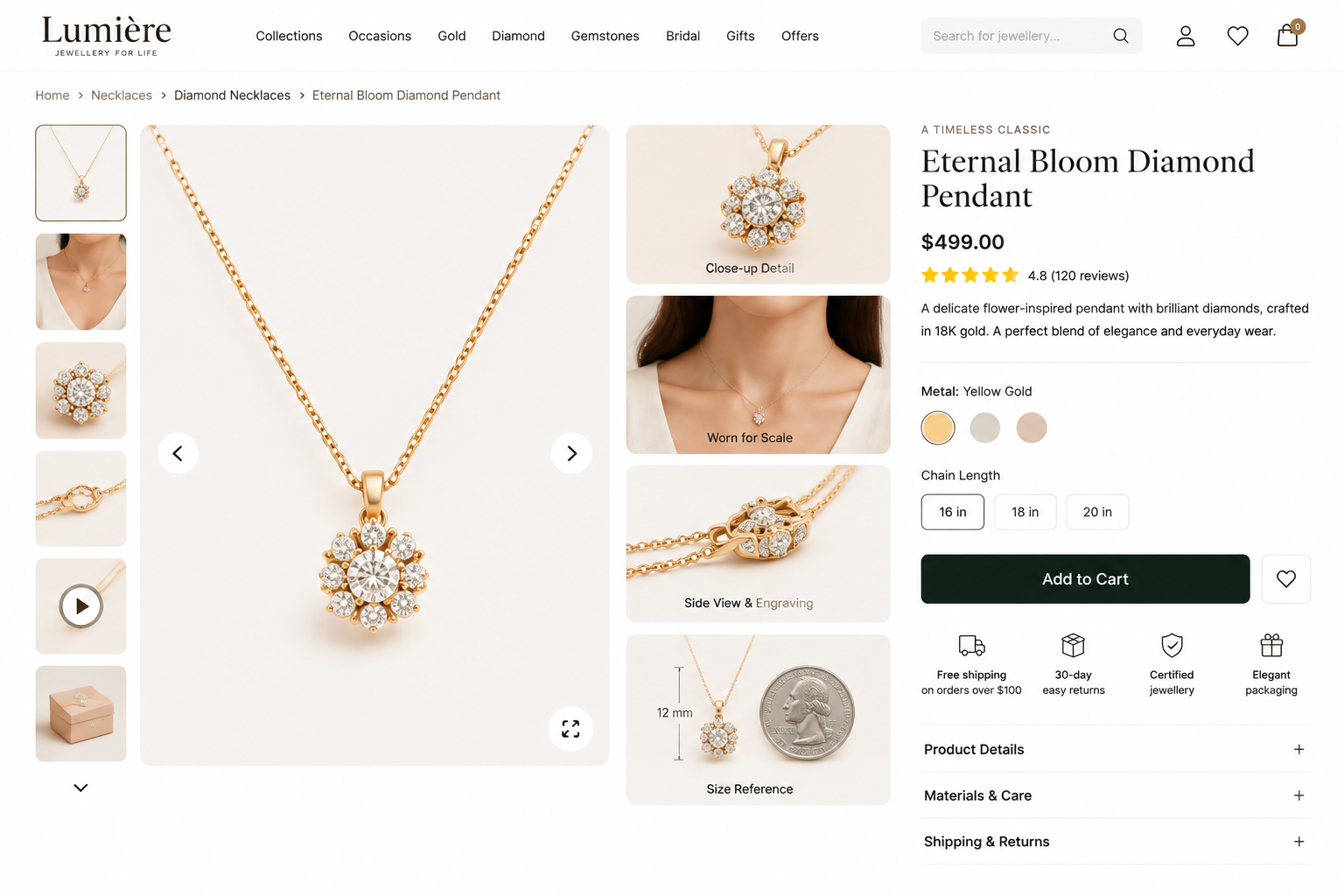
Photography does more work here than in almost any other category, because the shopper is trying to judge craftsmanship and size from a screen. A single catalogue shot is not enough.
- Shoot every piece on a plain background so the shape and metal colour are honest.
- Add a close-up of the setting, the clasp, the stone and any engraving. This is where quality is visible, and it is what justifies your price.
- Show the piece worn — on a hand, a neck, an ear. This is the only reliable way for someone to judge scale.
- Give a size reference where a worn shot is not possible: the piece beside a familiar object, or the measurements marked on the image and repeated as text.
- A short video or a slow turn shows sparkle and movement, which no still photograph captures.
- Keep lighting and background the same across the catalogue. Listing pages look untidy when one piece is shot warm and the next cold, and the colour of gold is exactly what customers are trying to judge.
Media is assembled with the image element and a gallery slider, with video where movement matters. Gallery layout and thumbnail spacing are set in the product details page settings.
Foundation · 2 min
3. Zoom
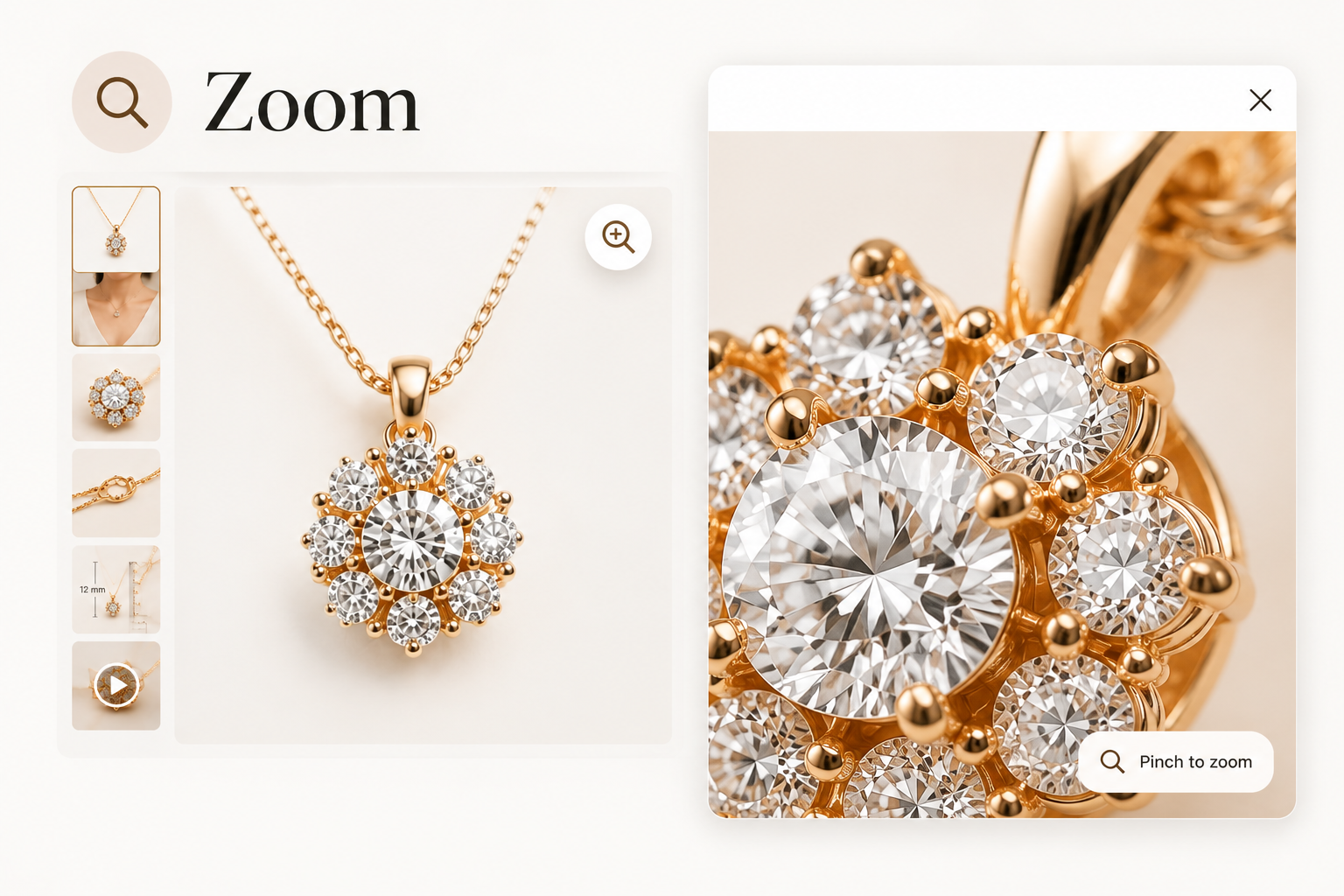
Zoom is not a nice extra in jewellery; it is how a shopper inspects the piece. They are looking for the quality of the setting, the finish of the metal and the clarity of the stone.
- Supply images large enough to survive being enlarged. A zoom that turns blurry looks like something is being hidden, which is the opposite of what the feature is for.
- On a phone, full screen with pinch to zoom is what people expect. A small magnifier that only works with a mouse leaves most of your customers out.
- Make it obvious that zoom exists. A quiet magnifier icon gets missed; letting the image open on tap does not.
- Zoom the detail shots too, not only the first image. The clasp and the setting are what people want to look at closely.
Large images are also why jewellery pages feel slow, so export at the size the image is displayed rather than uploading the full camera file, set the width and height so the page does not jump as pictures load, and let the gallery load the rest only as the shopper moves through it. The first image should still be sharp — it is the one that has to arrive quickly.
Foundation · 3 min
4. Materials and purity
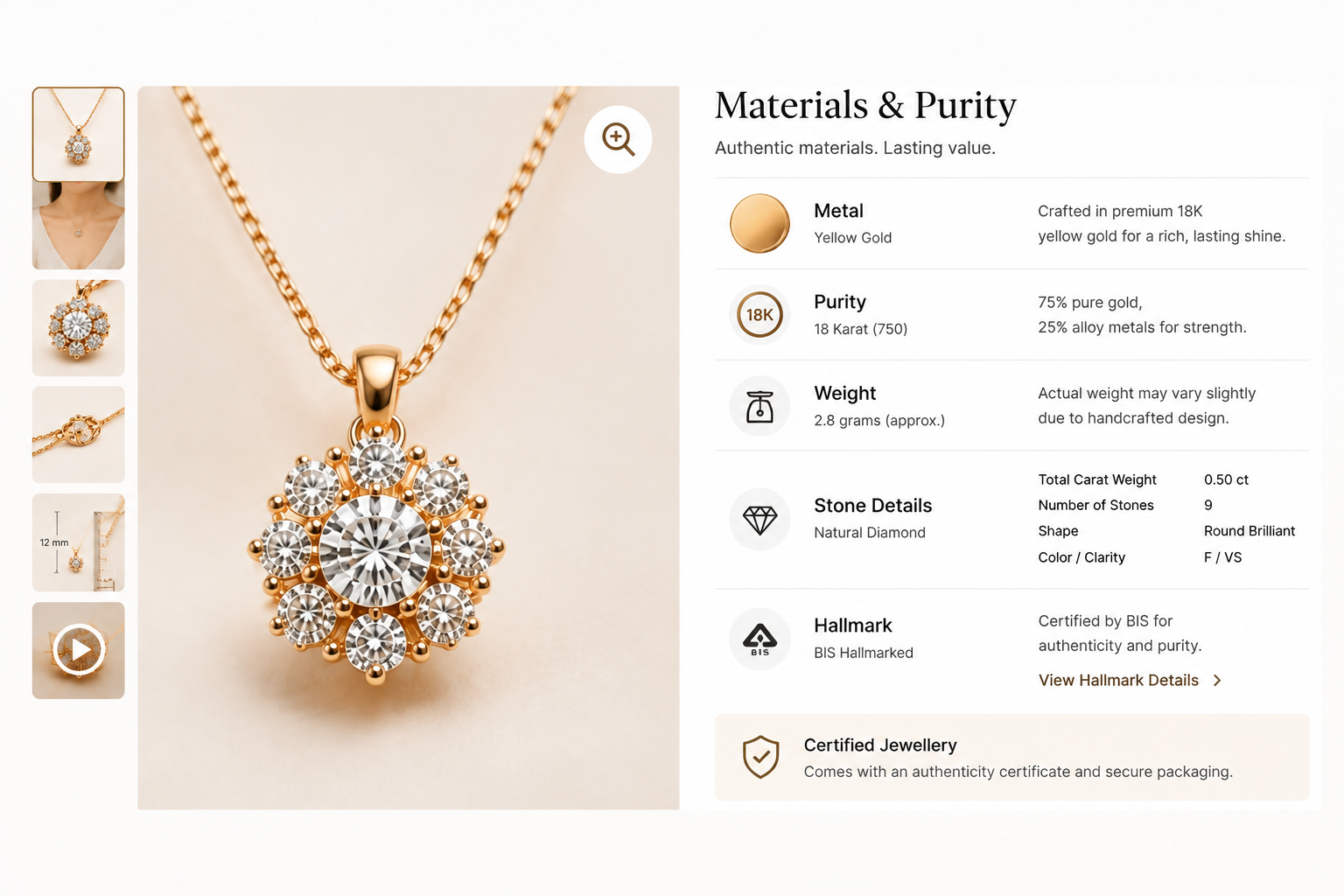
Everything a customer wants to verify about a piece is in this block, so write it plainly and keep it near the price rather than at the bottom of the page.
- State the metal and its purity in the way people buy it — 22K or 916 for gold, 18K or 750, sterling silver, platinum — and give both the karat and the fineness where you can.
- Give the weight of the piece, and the metal weight separately from the stone weight where the two differ. In gold, weight is half the price.
- For stones, say the type, the size or carat weight, the number of stones and, for diamonds, the cut, colour and clarity. Say whether a gemstone has been treated.
- Say plainly when a piece is plated or filled rather than solid, and what it is plated over. Customers find out eventually, and finding out later costs far more than saying so.
- Give the actual dimensions — length of a chain, diameter of a bangle, height of a pendant — in millimetres. This is what makes a photograph believable.
- Where a metal colour is offered as a choice, always show the name beside the swatch. A row of gold, rose gold and white gold circles is unreadable to anyone who cannot distinguish them.
- Add a line on care and storage. It costs nothing and it prevents a tarnished chain being reported as a fault.
In India, gold jewellery sold in notified districts must be hallmarked, and a hallmarked piece carries three marks: the BIS standard mark, the purity in karat and fineness, and a six-digit HUID number. The jeweller is responsible for the purity of what they sell and must give a bill showing the article, its net weight, its purity and the hallmarking charge. Confirm the current rules for your own turnover and location, and treat this guide as design advice rather than legal advice.
Put this content in switchable panels or an expandable panel, written as real text rather than an image of a specification card.
Foundation · 2 min
5. Size selection
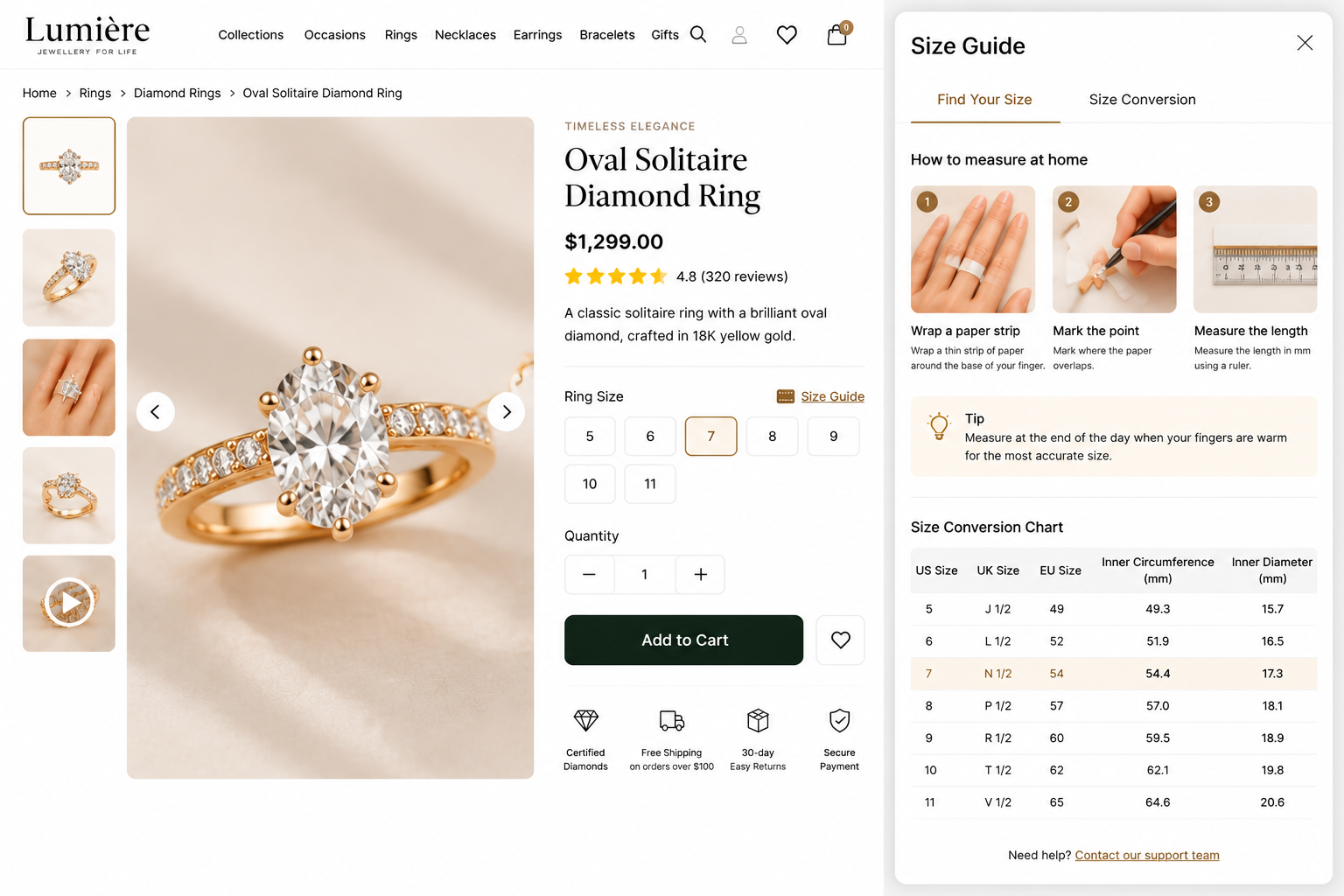
A ring that does not fit is the jewellery equivalent of a garment that does not fit, except that returning it is slower and resizing costs money. Helping people choose correctly is cheaper than handling the consequences.
- Offer a size guide next to the size selector, not in a tab at the bottom of the page. It should explain how to measure at home with a piece of thread or a ring the customer already owns.
- Give the size in the systems your customers use, and say which system you are using. Indian, US and UK ring sizes are all different numbers for the same finger.
- For chains, bangles and bracelets, give lengths and diameters in millimetres or inches, and say how the length is measured.
- Keep sizes that are out of stock visible and marked, with a way to be told when they return, rather than removing them.
- Say what happens if the size is wrong. A clear resizing or exchange policy stated before purchase removes the main reason people hesitate on a ring.
- For gifts, offer an adjustable option or a gift receipt, since the buyer often does not know the size.
Sizes are set up as product options, a chart can be attached with the product size chart, and an unavailable size can capture demand through the waiting list.
Foundation · 2 min
6. Certification
A certificate is the store’s answer to “how do I know this is real?” — but only if the customer can see it before paying, not after.
- Say which certificate comes with the piece and who issued it. A named laboratory means something; the word “certified” on its own does not.
- Show the certificate number on the product page, and a photograph of the certificate where you can.
- Write the important details as text as well — laboratory, number, what it covers. A photograph alone cannot be searched or read aloud, and this is exactly the content people search for.
- Explain in one line what the certificate does and does not cover. A diamond grading report is not a valuation, and a hallmark covers purity rather than the stones.
- Say what paperwork arrives in the box, and keep a copy in the customer’s account, because it is what an insurer or a buyer will ask for years later.
- Never imply certification you do not have. In this category it is the fastest way to lose a customer permanently, and it invites regulatory attention.
Certificates and paperwork sit well in an expandable panel beside the materials block, with the customer’s copies available through their account area.
Foundation · 2 min
7. Price transparency
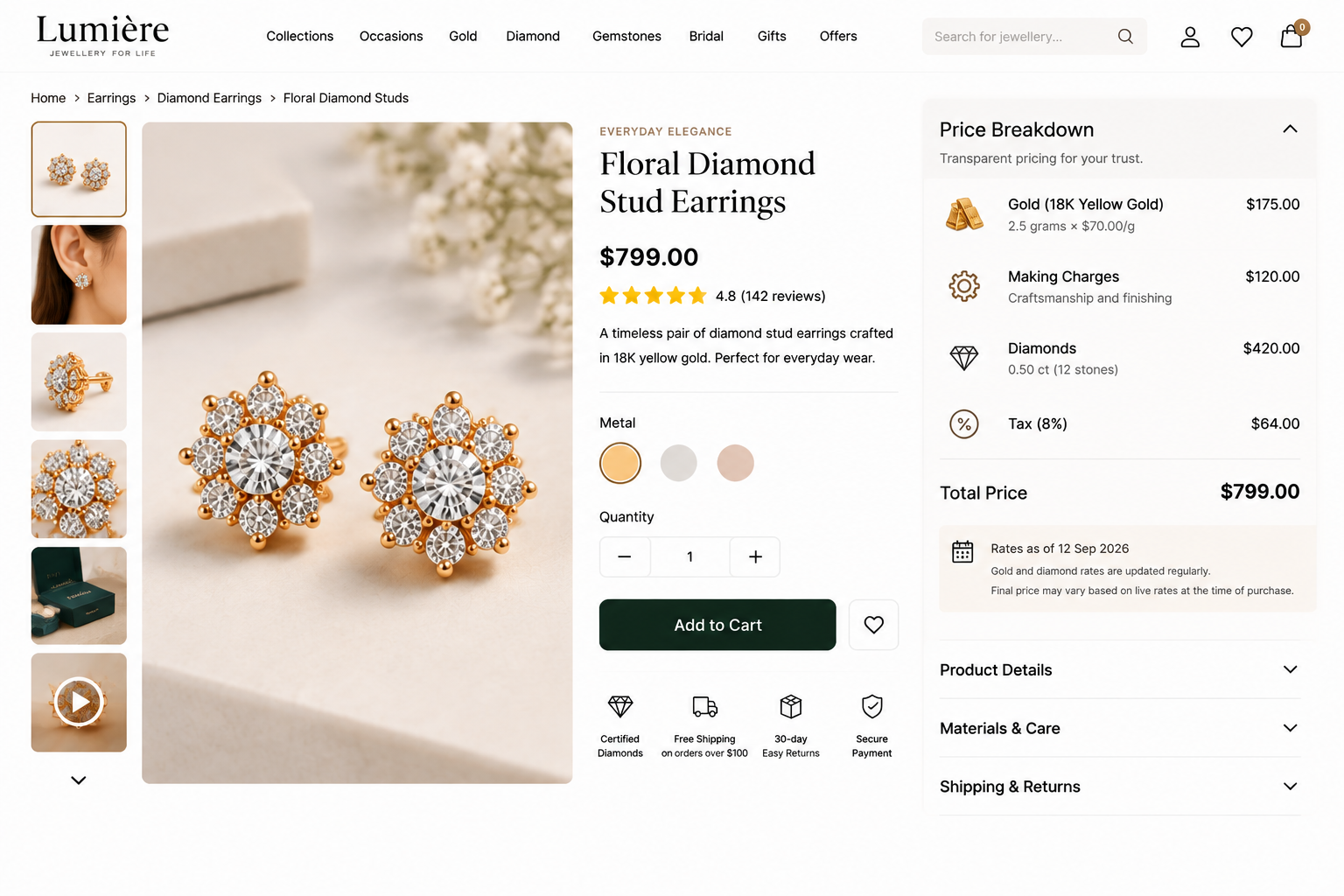
A jewellery price is built from parts, and metal rates change daily. Showing how the number is reached is what makes it credible — and it also explains why two similar-looking pieces cost different amounts.
- Break the price down: metal weight and rate, making charges, stone value, and taxes. A single total invites suspicion.
- Say how making charges are calculated, whether as a percentage or per gram, and whether they are included in the displayed price.
- Say when the price was set, if your rates move with the market, and how long a quoted price holds.
- Show the tax separately rather than folding it in silently.
- If you offer instalments, exchange of old gold or buyback, say so near the price. These are decision-changing facts, not footnotes.
- Where a piece is made to order, say the price is confirmed at the final weight, and give the range.
 22K Gold Kada  ·  BIS hallmarked, HUID on piece

  Gold        18.42 g × ₹—/g (today's rate)     ₹ ——,———
  Making      12%                               ₹  —,———
  Stones      none                              ₹      0
  GST         3%                                ₹    ———
  ─────────────────────────────────────────────────────
  Total                                         ₹ ——,———
  Price held for 30 minutes · rate updated daily

  Size  ( 2.4 ) ( 2.6 ) (✕2.8 — notify me )   [ Size guide ]
  Insured delivery, signature required · 12–14 Sep
Everything a jewellery buyer checks before paying, in one block.
Foundation · 2 min
8. Trust and security
A first-time customer is about to spend a lot of money with a store they do not know. Most of the work here is simply proving that you are a real business that will still be there next year.
- Publish your full business details — legal name, address, phone number and email — and answer the phone. A showroom address with a map does more for trust than any badge.
- Show the payment methods you accept, and let the payment page look and feel like the rest of the store.
- State the return, exchange and buyback terms plainly, including what happens to making charges. Jewellery returns are rarer than in clothing but far more anxious.
- Publish real reviews, including the critical ones, and reply to complaints in public.
- Avoid invented urgency. A countdown on a wedding purchase reads as pressure, and this is the category where pressure is least welcome.
- Say how the parcel is packed and delivered, since discreet, insured delivery is itself a trust signal.
Business details and policies belong in the footer, with a showroom shown on a map and reviews displayed through a data driven box.
Foundation · 2 min
9. Appointment or consultation
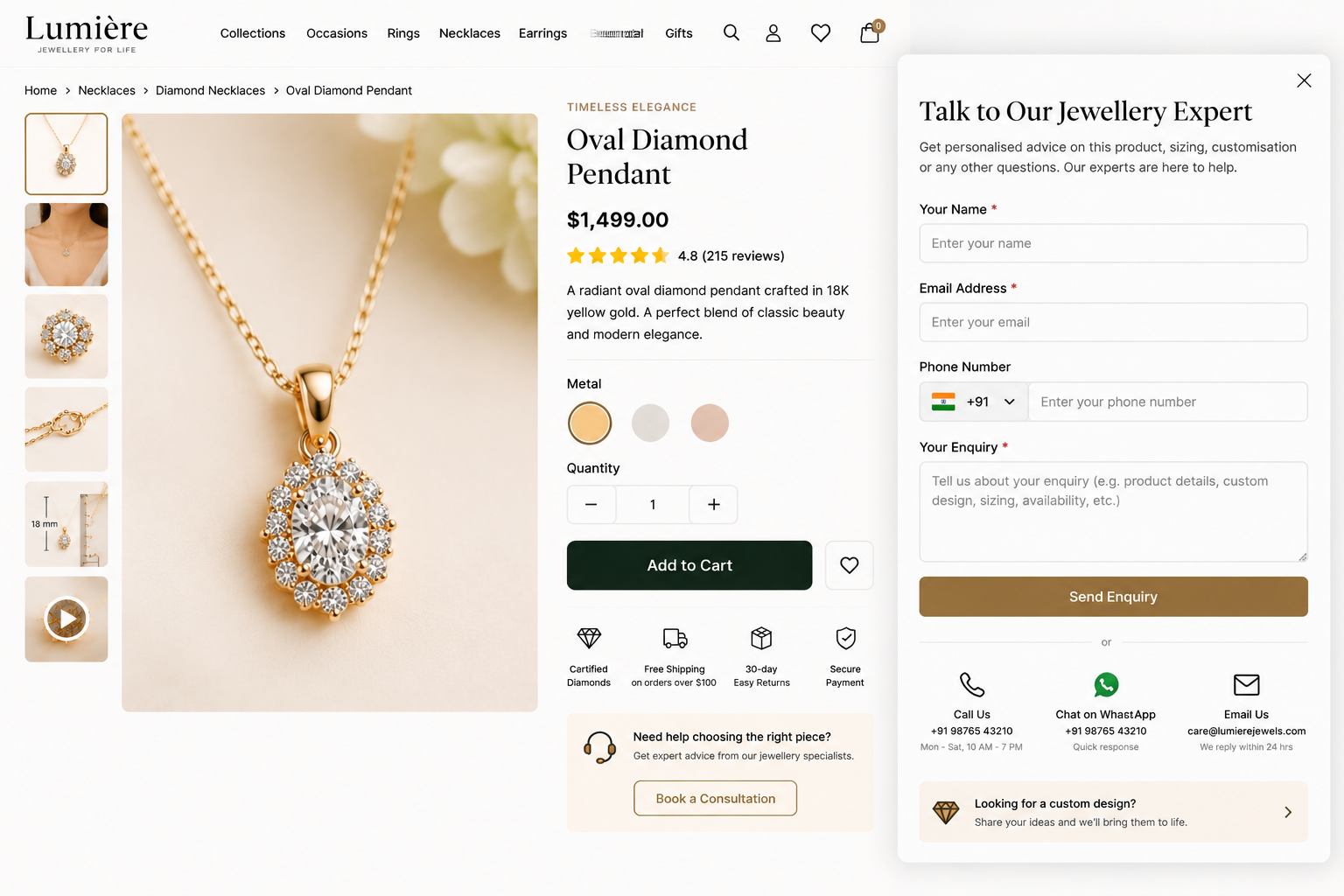
Above a certain price, people want to talk to someone before they buy. Offering that conversation costs you a form and some staff time, and it converts the customers who would otherwise close the tab.
- Offer a video call, a showroom visit or a callback, and let the customer pick which one.
- Keep the form short: name, contact, the piece they are interested in, and a couple of times that suit them.
- Say how quickly you will reply, and then reply that quickly. A promise of one working day, kept, is worth more than a live chat widget nobody answers.
- Put the option on expensive product pages and on anything made to order, not on every page — it should read as help, not as a hurdle.
- For custom work, ask for a budget range and a rough idea at the enquiry stage. It saves two emails and sets expectations early.
- Confirm the appointment by email with the time, the address or the meeting link, and what to bring.
Build the enquiry with a form, give it its own page for consultations and custom orders, and show the showroom on a map. Made-to-order pieces can be sold as pre-orders with the lead time stated.
Foundation · 2 min
10. Shipping and insurance
Sending something valuable through the post worries people. Saying exactly how you do it removes the worry, and it is one of the few places where detail is genuinely reassuring.
- Say the parcel is insured in transit, and up to what value.
- Say that delivery requires a signature or an identity check, so nobody expects it to be left at the door.
- Say the packaging is discreet and does not advertise what is inside.
- Give a tracking link, and a realistic dispatch and delivery estimate on the product page rather than only at checkout.
- Explain what happens if a parcel is lost or arrives damaged, and who the customer contacts. One clear paragraph prevents a great deal of anxiety.
- For international orders, say who pays customs duty and that delivery times vary at borders.
- Explain how a return is sent back safely, since customers will not want to guess with something this valuable.
Delivery promises can be carried by an attention banner, with the detail in a panel on the product page and address or access notes collected through a form.
Foundation · 2 min
11. Choosing a ZenBasket theme for your jewellery store
Everything above is platform-independent. If you are building on ZenBasket, start from the theme mapped to this category. From the ZenBasket theme collection; current pricing is on that page.
| If you sell | Start with | Why |
|---|---|---|
| Fine jewellery, gold and gemstone pieces | Gem Crown (free) | The mapped jewellery theme: collection-led and close-up led, built around trust signals rather than large catalogues. |
| Bridal and occasion jewellery | ShaadiVex (premium) | Built for wedding ranges, where the collection story and lead times matter more than fast browsing. |
| Handmade or artisan pieces | HueKraft (free) | A craft-led layout, where the maker and the material do more of the selling. |
How to judge a jewellery theme in ten minutes
Open the live demo on your phone, not your laptop:
- Does the gallery hold several images and open full screen with clean zoom?
- Is there room near the price for purity, weight and a price breakdown?
- Can the product page carry long materials, certificate and shipping content without becoming a wall of text?
- Can a piece carry metal colour and size as options, each with its own price?
- Is there a sensible place for a consultation or enquiry button?
- Does the layout still look right with only twelve products in it?
A theme failing the first two costs more to fix than the price gap between any two themes in the collection. You can apply and customise a paid theme to try it before buying, although it cannot be published live until it is purchased — see customising site themes.
Foundation · 2 min
12. Building it in ZenBasket
Sections you design yourself — a collection banner, a consultation block, a care guide — are added to a blank section and filled with elements from the left panel. The pages the store already provides, such as the product page, the listing page and the cart, are edited in place by double-clicking the section. Product data itself — purity, weights, sizes, prices and stock — is managed in the catalogue, and the storefront reads from it, so agree your field names there first.
| What this guide asks for | What to use |
|---|---|
| Detailed gallery with macro and worn shots | Image element and slider |
| Sparkle and movement | Video or advanced video |
| Gallery layout, zoom and buy block | Product details page settings |
| Materials, certificate, care and shipping content | Switchable panels or expandable panels |
| Metal colour and size options | Product options and variants |
| Ring and chain size charts | Product size chart |
| Out-of-stock sizes and made-to-order pieces | Waiting list and pre-order |
| Consultation and custom-order enquiries | Forms on their own page |
| Showroom location | Map element |
| Collection storytelling on the homepage | Content rotator and split view |
| Shoppable styled photographs | Hotspot |
| Certified or new-arrival marks on tiles | Product badges |
| Category navigation and filters | Navigation menu and product list page settings |
| Logos, colours and typography | Customising site themes and store assets |
New to the builder? Start with Getting started, then adding sections and customising them.
Foundation · 4 min
13. Frequently asked questions
How many photographs does a jewellery product need?
At least three: a plain shot showing the true shape and metal colour, a close-up of the setting or clasp, and the piece worn so the size reads. Add a short video where sparkle or movement matters.
How do I show how big a piece really is?
Show it worn, give the actual dimensions in millimetres as text, and use a familiar object for scale where a worn shot is not possible. Photographs alone always mislead on size.
Why does zoom matter so much in jewellery?
Because it is how customers inspect the setting, the finish and the stone. Supply images large enough to stay sharp when enlarged, and make zoom work full screen on a phone.
What should the materials section say?
The metal and purity, the weight, the stone type and size, whether a stone is treated, whether the piece is solid or plated, the dimensions, and a line on care.
Is hallmarking compulsory for gold jewellery in India?
In notified districts, yes, with an exemption for jewellers below a turnover threshold. A hallmarked piece carries the BIS mark, the purity in karat and fineness, and a six-digit HUID number. Confirm the current rules for your location and turnover.
How should I present certificates?
Name the laboratory, show the certificate number and a photograph of the certificate, and write the key details as text. Explain in one line what the certificate covers and what it does not.
Should I show a price breakdown?
Yes. Metal weight and rate, making charges, stone value and tax. A single number with no explanation invites suspicion, and the breakdown explains why two similar pieces differ in price.
How do I handle daily metal rate changes?
Say when the price was set, how long it holds, and that rates move with the market. For made-to-order pieces, give a range and confirm the price at the final weight.
How do I help customers choose a ring size?
Put a size guide beside the selector explaining how to measure at home, say which sizing system you use, and state your resizing or exchange policy before purchase.
What builds trust for a first-time jewellery buyer?
Real business details and a phone that is answered, a showroom address on a map, clear return and buyback terms, honest reviews, and no invented urgency.
Should I offer consultations?
On expensive and made-to-order pieces, yes. Offer a video call, a showroom visit or a callback, keep the form short, and reply as fast as you promise.
What should the shipping section say?
That the parcel is insured and up to what value, that delivery needs a signature, that packaging is discreet, how tracking works, and what happens if a parcel is lost or damaged.
Should out-of-stock sizes be hidden?
No. Show them marked as unavailable with a way to be notified, so shoppers can see the piece is made in their size at all.
What is the best ZenBasket theme for a jewellery store?
Gem Crown is the mapped jewellery theme, collection-led and built around close-up imagery and trust signals. ShaadiVex suits bridal ranges and HueKraft suits handmade pieces.